Atropine: Difference between revisions
From Proteopedia
Jump to navigationJump to search
David Canner (talk | contribs) No edit summary |
No edit summary |
||
| (16 intermediate revisions by 3 users not shown) | |||
| Line 1: | Line 1: | ||
[[Image:Atropine structure.jpg|thumb| | <StructureSection load='1th6' size='350' side='right' scene='' caption='Phospholipase A2 complex with atropine and sulfate (PDB code [[1th6]])'> | ||
[[Image:Atropine structure.jpg|thumb|right|1000px|Structure of Atropine]] | |||
{{Clear}} | |||
[[Atropine]] is an alkaloid drug derived from levohyscocyamine, a plant compound found in the family Solanaceae<ref> Atropine. Encyclopedia Brittanica. http://www.britannica.com/EBchecked/topic/42015/atropine</ref>. It's chemical name is 8-methyl-8-azabicycolo[3.2.1]oct-3-yl) 3-hydroxy-2-phenylpropanoate, and the most common medicinal form of atropine is atrophine sulfate ((C17H23NO3)2·H2SO4·H2O)<ref> Atropine. New World Encyclopedia. http://www.newworldencyclopedia.org/entry/Atropine </ref>. It is a competitive antagonist of both acetylcholine receptors and phospholipase 2A and has a variety of effects on both humans and animals. | [[Atropine]] is an alkaloid drug derived from levohyscocyamine, a plant compound found in the family Solanaceae<ref> Atropine. Encyclopedia Brittanica. http://www.britannica.com/EBchecked/topic/42015/atropine</ref>. It's chemical name is 8-methyl-8-azabicycolo[3.2.1]oct-3-yl) 3-hydroxy-2-phenylpropanoate, and the most common medicinal form of atropine is atrophine sulfate ((C17H23NO3)2·H2SO4·H2O)<ref> Atropine. New World Encyclopedia. http://www.newworldencyclopedia.org/entry/Atropine </ref>. It is a competitive antagonist of both acetylcholine receptors and phospholipase 2A and has a variety of effects on both humans and animals. | ||
| Line 5: | Line 7: | ||
As a plant compound, Atropine has been used for hundreds of years. Its first recorded use was in the 4th year of B.C.E, where it was used to treat wounds, gout, sleeplessnes, and was even thought to be a love potion<ref> Atropine. New World Encyclopedia. http://www.newworldencyclopedia.org/entry/Atropine </ref>. It was also used by Cleopatra and women in the Renaissance era to dilate their pupils to give them a more beautiful appearance<ref> Atropine. New World Encyclopedia. http://www.newworldencyclopedia.org/entry/Atropine </ref>. It has since been studied extensively and, although it is inherently poisonous, it is now used for a wide spectrum of medical ailments. It can be given orally, intravenously, rectally, or subcutaneously (in animals). | As a plant compound, Atropine has been used for hundreds of years. Its first recorded use was in the 4th year of B.C.E, where it was used to treat wounds, gout, sleeplessnes, and was even thought to be a love potion<ref> Atropine. New World Encyclopedia. http://www.newworldencyclopedia.org/entry/Atropine </ref>. It was also used by Cleopatra and women in the Renaissance era to dilate their pupils to give them a more beautiful appearance<ref> Atropine. New World Encyclopedia. http://www.newworldencyclopedia.org/entry/Atropine </ref>. It has since been studied extensively and, although it is inherently poisonous, it is now used for a wide spectrum of medical ailments. It can be given orally, intravenously, rectally, or subcutaneously (in animals). | ||
{{clear}} | |||
__TOC__ | __TOC__ | ||
=== Function and Basic Mechanism === | === Function and Basic Mechanism === | ||
| Line 22: | Line 23: | ||
[[Image:Synapse.jpg|thumb|left|350px|Synapse]]<ref>Image from: http://www.neurevolution.net/category/history/page/2/ </ref> | [[Image:Synapse.jpg|thumb|left|350px|Synapse]]<ref>Image from: http://www.neurevolution.net/category/history/page/2/ </ref> | ||
{{Clear}} | |||
==== Inhibition of Acetylcholine Receptors ==== | ==== Inhibition of Acetylcholine Receptors ==== | ||
The image to the left depicts a synapse. A neurotransmitter, such as acetylcholine, goes across the synaptic cleft and binds to its receptor, which can be seen in great detail in the 3D image | The image to the left depicts a synapse. A neurotransmitter, such as acetylcholine, goes across the synaptic cleft and binds to its receptor, which can be seen in great detail in the 3D image. Atropine inhibits the effect of acetylcholine by complexing the acetylcholine receptor on the other side of the cleft, subsequently inhibiting the binding of acetylcholine. If atropine does not allow acetylcholine to bind to the acetylcholine receptor, then the effects of acetylcholine are inhibited. This prevents activation of the parasympathetic nervous system and has a wide variety of medical effects. | ||
=== Medical Uses === | === Medical Uses === | ||
| Line 35: | Line 36: | ||
Atropine is also a good antidote for poisoning by organophosphates and nerve gases, prime agents in bioterrorism<ref> Atropine. New World Encyclopedia. http://www.newworldencyclopedia.org/entry/Atropine </ref>, because Atropine blocks acetylcholine at muscscarininc receptors. Atropine, however, has side effects that include nausea, dizziness, blurred visions, tachycardia, and hallucinations, and due to these side effects it has recently become more popular as a recreational drug. | Atropine is also a good antidote for poisoning by organophosphates and nerve gases, prime agents in bioterrorism<ref> Atropine. New World Encyclopedia. http://www.newworldencyclopedia.org/entry/Atropine </ref>, because Atropine blocks acetylcholine at muscscarininc receptors. Atropine, however, has side effects that include nausea, dizziness, blurred visions, tachycardia, and hallucinations, and due to these side effects it has recently become more popular as a recreational drug. | ||
[[Image:atropine.jpg|thumb| | [[Image:atropine.jpg|thumb|left|350px|Atropine Tablets]] <ref>Atropine Diphenoxylate. http://www.everydayhealth.com/drugs/atropine-diphenoxylate </ref> | ||
{{Clear}} | |||
==== Uses in Veterinary Medicine ==== | ==== Uses in Veterinary Medicine ==== | ||
| Line 47: | Line 48: | ||
The proper dose of atropine is approximately 0.1 mg/ml in adults and 0.05 mg/ml in children when taken orally or given intravenously <ref>Atropine. http://www.rxlist.com/atropine-drug.htm </ref>. Atropine can be given orally, intravenously, rectally, or topically, and in veterinary medicine, it can be given intramuscularly or subcutaneously. | The proper dose of atropine is approximately 0.1 mg/ml in adults and 0.05 mg/ml in children when taken orally or given intravenously <ref>Atropine. http://www.rxlist.com/atropine-drug.htm </ref>. Atropine can be given orally, intravenously, rectally, or topically, and in veterinary medicine, it can be given intramuscularly or subcutaneously. | ||
== '''Interaction of Atropine with Phospholipase A2''' == | |||
< | <scene name='42/420811/Cv/1'>Atropine in complex with phospholipase A2</scene> ([[1th6]]). | ||
[[ | |||
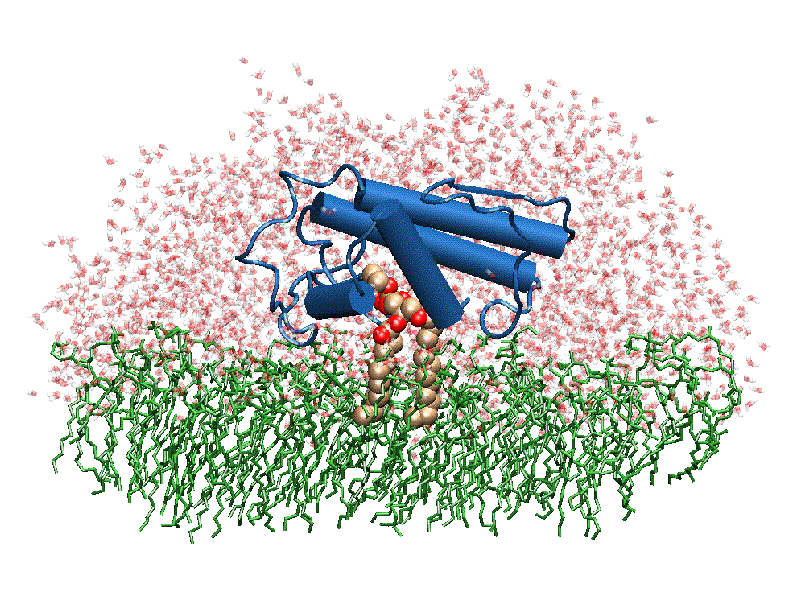
[[Image:Phospholipase A2.gif|thumb|left|350px|Phospholipase 2A in complex with cell membrane]] | |||
{{Clear}} | |||
In addition to its ability to form complexes with acetylcholine receptors, atropine can also complex with phospholipase A2. Phospholipase A2 is a category of heat-stable enzymes which are involved in cell signaling processes, such as the inflammatory response. <ref>Kumar, Jainendra; Bala, Priti; Vihwal, Preeti. ''Analysis of Interaction of atropine with phospholipase A2 (1th6.pdb)''. Department of Botany and Biotechnlogy, College of Commerce, Patna, India.</ref>. Phospholipase 2A is an upstream regulator of inflammatory processes, and more specifically, it recognizes the sn-2 acyl bond of phospholipids and catalytically hydrolyzes the bond, releasing lysophospholipids <ref> Phospholipase A2. http://www.worldlingo.com/ma/enwiki/en/Phospholipase_A2 </ref>. | In addition to its ability to form complexes with acetylcholine receptors, atropine can also complex with phospholipase A2. Phospholipase A2 is a category of heat-stable enzymes which are involved in cell signaling processes, such as the inflammatory response. <ref>Kumar, Jainendra; Bala, Priti; Vihwal, Preeti. ''Analysis of Interaction of atropine with phospholipase A2 (1th6.pdb)''. Department of Botany and Biotechnlogy, College of Commerce, Patna, India.</ref>. Phospholipase 2A is an upstream regulator of inflammatory processes, and more specifically, it recognizes the sn-2 acyl bond of phospholipids and catalytically hydrolyzes the bond, releasing lysophospholipids <ref> Phospholipase A2. http://www.worldlingo.com/ma/enwiki/en/Phospholipase_A2 </ref>. | ||
This protein is found in mammals, reptile venom, and bacteria. In humans, the overproduction of phospholipase A2 leads to neurologic disorders such as schizophrenia and possibly autism <ref> Phospholipase A2. http://www.worldlingo.com/ma/enwiki/en/Phospholipase_A2 </ref>. An inhibitor of Phospholipase A2, such as Atropine, could be used to treat disorders associated with neural trauma, since Phospholipase A2 increases inflammation which could be potentially complicate neural trauma cases <ref> Phospholipase A2. http://www.worldlingo.com/ma/enwiki/en/Phospholipase_A2 </ref>. | This protein is found in mammals, reptile venom, and bacteria. In humans, the overproduction of phospholipase A2 leads to neurologic disorders such as schizophrenia and possibly autism <ref> Phospholipase A2. http://www.worldlingo.com/ma/enwiki/en/Phospholipase_A2 </ref>. An inhibitor of Phospholipase A2, such as Atropine, could be used to treat disorders associated with neural trauma, since Phospholipase A2 increases inflammation which could be potentially complicate neural trauma cases <ref> Phospholipase A2. http://www.worldlingo.com/ma/enwiki/en/Phospholipase_A2 </ref>. | ||
The image to the | The image to the above shows the membrane-bound phospholipase A2 in blue <ref> pla2. http://www.ks.uiuc.edu/Research/smd_imd/pla2/pla2.gif </ref>. | ||
==== '''Atropine in the Active Site of Phospholipase | ==== '''Atropine in the Active Site of Phospholipase A2''' ==== | ||
Atropine is an inhibitor of phospholipase 2A, and can be seen in complex with this enzyme on the left. The <scene name='Sandbox_53/Atropine_structure/1'>structure of atropine</scene> can be seen more clearly in gray using the ball-and stick representation of the drug and protein. It can also be seen in green in this <scene name='Sandbox_53/Phospholipase2a_composition/1'>space-filling model</scene>, where protein appears in brown, ligands appear in green, and solvents appear in blue. Finally, the | Atropine is an inhibitor of phospholipase 2A, and can be seen in complex with this enzyme on the left. The <scene name='Sandbox_53/Atropine_structure/1'>structure of atropine</scene> can be seen more clearly in gray using the ball-and stick representation of the drug and protein. It can also be seen in green in this <scene name='Sandbox_53/Phospholipase2a_composition/1'>space-filling model</scene>, where protein appears in brown, ligands appear in green, and solvents appear in blue. Finally, the | ||
| Line 69: | Line 69: | ||
Removing the labels, atropine can be seen making contact with the atoms emphasized by the space filling model, interacting with the <scene name='Sandbox_53/Phospholipase2a_interactions/1'>active site</scene> of phospholipase 2A through white as-tricks. | Removing the labels, atropine can be seen making contact with the atoms emphasized by the space filling model, interacting with the <scene name='Sandbox_53/Phospholipase2a_interactions/1'>active site</scene> of phospholipase 2A through white as-tricks. | ||
</StructureSection> | |||
== '''References''' == | == '''References''' == | ||
<references/> | <references/> | ||
Latest revision as of 12:59, 13 November 2019
| ||||||||||||


References
Proteopedia Page Contributors and Editors (what is this?)
Lindsey Hayes, OCA, Michal Harel, Alexander Berchansky, David Canner