Main Page: Difference between revisions

From Proteopedia
Jump to navigationJump to search
Jaime Prilusky (talk | contribs)
No edit summary
Angel Herraez (talk | contribs)
No edit summary
 
(46 intermediate revisions by 3 users not shown)
Line 1: Line 1:
<table id="tableColumnsMainPage" style="width:100%;border:2px solid #ddd;border-collapse: collapse;table-layout: fixed; ">
<table id="tableColumnsMainPage" >
<tr><td colspan='4' style="background:#F5F5FC;border:1px solid #ddd;">
<tr><td colspan='3' style="background:#F5F5FC; border:1px solid #ddd;">
<div style="top:+0.2em; font-size:1.2em; padding:5px 5px 5px 10px; float:right;">'''''ISSN 2310-6301'''''</div>
<div id="issn">'''''ISSN 2310-6301'''''</div>
 
<div id="headerOne">As <b>life is more than 2D</b>, Proteopedia helps to bridge the gap between 3D structure and function of biomacromolecules.</div>
<span style="border:none; margin:0; padding:0.3em; color:#000; font-style: italic; font-size: 1.2em;">
<div id="headerTwo"><b>Proteopedia</b> presents this information in a user-friendly way as a '''collaborative & free 3D-encyclopedia of proteins & other biomolecules.'''
<b>As life is more than 2D</b>, Proteopedia helps to bridge the 3D relationships between function & structure of biomacromolecules
</div>
</span>
</td>
 
 
</td></tr>
 
<tr>
<th style="padding: 10px;background-color: #33ff7b">Selected Pages</th>
<th style="padding: 10px;background-color: #dae4d9">Art on Science</th>
<th style="padding: 10px;background-color: #f1b840">Journals</th>
<th style="padding: 10px;background-color: #79baff">Education</th>
</tr>
</tr>
 
<tr id="mainPageSections"><th class="mainPageSectionA">Selected Research Pages</th>
<tr>
<th class="mainPageSectionB">In Journals</th>
<td style="padding: 5px;"> {{Proteopedia:Featured SEL/{{#expr: {{#time:U}} mod {{Proteopedia:Number of SEL articles}}}}}}</td>
<th class="mainPageSectionC">Education</th>
<td style="padding: 5px;">{{Proteopedia:Featured ART/{{#expr: {{#time:U}} mod {{Proteopedia:Number of ART articles}}}}}}</td>
<td style="padding: 5px;"> {{Proteopedia:Featured JRN/{{#expr: {{#time:U}} mod {{Proteopedia:Number of JRN articles}}}}}}</td>
<td style="padding: 5px;"> {{Proteopedia:Featured EDU/{{#expr: {{#time:U}} mod {{Proteopedia:Number of EDU articles}}}}}}</td>
</tr>
</tr>
 
<tr id="rowFeatured"><td>{{Proteopedia:Featured SEL/{{#expr: {{#time:U}} mod {{Proteopedia:Number of SEL articles}}}}}}</td>
<tr style="font-size: 1.2em; text-align: center;">
<td>{{Proteopedia:Featured JRN/{{#expr: {{#time:U}} mod {{Proteopedia:Number of JRN articles}}}}}}</td>
<td style="padding: 10px;background-color: #33ff7b"></td>
<td>{{Proteopedia:Featured EDU/{{#expr: {{#time:U}} mod {{Proteopedia:Number of EDU articles}}}}}}</td>
<td style="padding: 10px;background-color: #dae4d9"></td>
<td style="padding: 10px;background-color: #f1b840"></td>
<td style="padding: 10px;background-color: #79baff"></td>
</tr>
</tr>
 
<tr id="rowClosingColors"><td class="mainPageSectionA">&nbsp;</td>
 
<td class="mainPageSectionB">&nbsp;</td>
<tr style="font-size: 1.2em; text-align: center;">
<td class="mainPageSectionC">&nbsp;</td>
 
</tr>
<td style="padding: 10px;>
<tr id="rowHelp">
<p>[[Help:Contents#For_authors:_contributing_content|How to add content to Proteopedia]]</p>
<td>
<p>[[Proteopedia:Video_Guide|Video Guides]]</p>
<p>
<p>[[Who knows]] ...</p>
[[Help:Contents#For_authors:_contributing_content|How to add content to Proteopedia]] <br>
</td>
[[Proteopedia:Video_Guide|Video Guides]] <br>
 
[[Who knows]] ...
<td style="padding: 10px;>
</p>
<p>[[:Category:PDB Art|List of Art on Science pages in Proteopedia]]</p>
</td>
</td>
 
<td>
<td style="padding: 10px;>
<p>
<p>[[I3DC|What is an Interactive 3D Complement ('''I3DC''')? ]]</p>
[[I3DC|About Interactive 3D Complements - '''I3DCs''']] <br>
<p>[[Proteopedia:I3DC|List of I3DCs]]</p>
[[Proteopedia:I3DC|List of I3DCs]] <br>
<p>[[How to get an I3DC for your paper]]</p>
[[How to get an I3DC for your paper]]
 
</p>
</td>
</td>
 
<td>
<td style="padding: 10px;>
<p>
<p>[[Teaching Strategies Using Proteopedia]]</p>
[[Teaching strategies using Proteopedia]] <br>
<p>[[Teaching_Scenes%2C_Tutorials%2C_and_Educators%27_Pages|Examples of Pages for Teaching]]</p>
[[Teaching_Scenes%2C_Tutorials%2C_and_Educators%27_Pages|Examples of pages for teaching]] <br>
<p>[[Help:Contents#For_authors:_contributing_content|How to add content to Proteopedia]]</p>
[[Help:Contents#For_authors:_contributing_content|How to add content to Proteopedia]]
</p>
</td>
</td>
</tr>
</tr>
 
<tr id="rowBottomLinks">
<tr><td colspan='4' >
<td colspan="3">
<table width='100%' style="padding: 10px; background-color: #d7d8f9; font-size: 1.5em;"><tr>  
<table>
<tr>  
<td>[[Proteopedia:About|About]]</td>
<td>[http://proteopedia.org/cgi-bin/contact Contact]</td>
<td>[[Special:Contact|Contact]]</td>
<td>[[Template:MainPageNews|Hot News]]</td>
<td>[[Proteopedia:Table of Contents|Table of Contents]]</td>
<td>[[Proteopedia:Structure Index|Structure Index]]</td>
<td>[[Help:Contents|Help]]</td>
</tr></table>
</tr>
</td></tr>
</table>
</td>
</tr>
</table>
</table>

Latest revision as of 15:44, 16 February 2026

ISSN 2310-6301
As life is more than 2D, Proteopedia helps to bridge the gap between 3D structure and function of biomacromolecules.
Proteopedia presents this information in a user-friendly way as a collaborative & free 3D-encyclopedia of proteins & other biomolecules.
Selected Research Pages In Journals Education
Coronavirus Spike Protein Membrane Fusion

by Eric Martz
SARS-CoV-2 spike protein "spears" the host membrane with a fusion peptide and drags the virus envelope membrane transmembrane domain close to the host membrane, initiating fusion. This moves the virus RNA genome into the host cell, initiating infection.
>>> Visit this page >>>

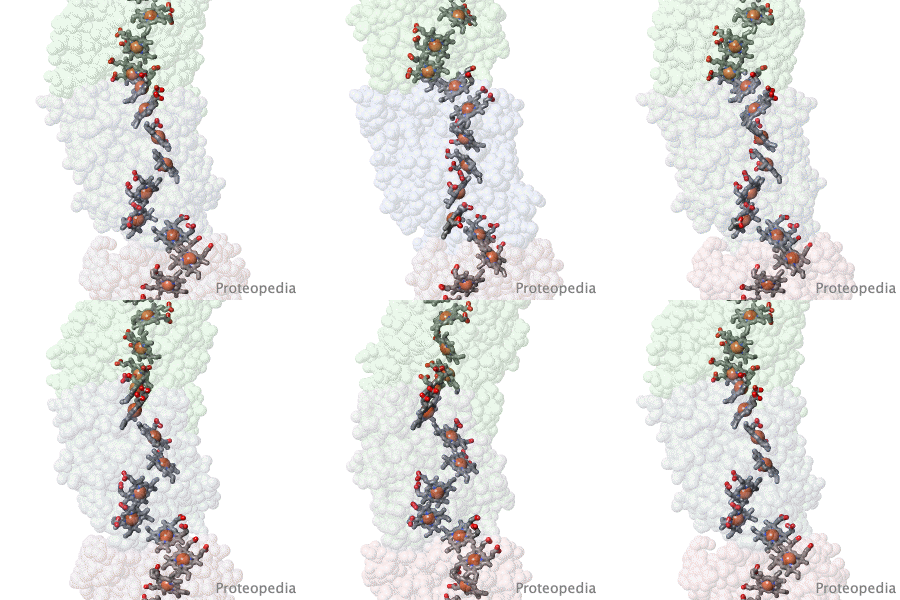
Geobacter nanowire structure surprise.

F Wang, Y Gu, JP O'Brien, SM Yi, SE Yalcin, V Srikanth, C Shen, D Vu, NL Ing, AI Hochbaum, EH Egelman, NS Malvankar. Cell 2019 doi: 10.1016/j.cell.2019.03.029
Bacteria living in anaerobic environments (no oxygen) need alternative electron acceptors in order to get energy from their food. An acceptor abundant in the earth's crust is red iron oxide ("rust"), which gets reduced to black iron oxide (magnetite). Many bacteria, such as Geobacter, get their metabolic energy by transferring electrons to acceptors that are multiple cell diameters distant, using protein nanowires. These were long thought to be pili. But when the structure of the nanowires was solved in 2019, to everyone's surprise, they turned out to be unprecedented linear polymers of multi-heme cytochromes. The hemes form an electrically conductive chain in the cores of these nanowires.

>>> Visit I3DC Interactive Visualizations >>>

Eastern Equine Encephalitis virus
Although only a few people in the USA get Eastern Equine Encephalitis every year, the fatality rate is 30%, and many survivors have ongoing neurological problems. The virus is transmitted by mosquitoes from animals, especially birds, to humans. This RNA virus has a complicated capsid (a slab of which is shown) composed of protein shells with an enclosed lipid bilayer. The structures of virus capsids can be explored using free FirstGlance in Jmol.

>>> Visit I3DC Interactive Visualizations >>>


How to add content to Proteopedia
Video Guides
Who knows ...

About Interactive 3D Complements - I3DCs
List of I3DCs
How to get an I3DC for your paper

Teaching strategies using Proteopedia
Examples of pages for teaching
How to add content to Proteopedia

Proteopedia Page Contributors and Editors (what is this?)

Jaime Prilusky, Joel L. Sussman, Angel Herraez