| Actin is a family of globular proteins that form microfilaments. It is the most abundant protein in eukaryotes [1]. They can be found in virtually all eukaryotic cells and come in two main forms, F-actin and G actin. Actin is responsible for many contraction properties in muscles.
Vertebrates have 3 main groups of actin isoforms, alpha, beta, and gamma. Alpha actins play a major role in muscle contraction mechanism. Beta and gamma actins are involved in the regulation of cell motility. Actin has the capability to bind with other molecules, most notably myosin and ATP, in order to carry out its function.
Function
Actins are highly conserved proteins that are involved in various types of cell motility and are ubiquitously expressed in all eukaryotic cells. The main function of ACTA1 gives directions to make the alpha (a)-actin. Actins are detrimental to cell movement and the contraction of muscle fibers. They are also used to help maintain the cytoskeleton. alpha skeletal actin is an essential component of sarcomeres, which are the basic contractile unit of muscle fibers.
Disease
Mutations in the human skeletal muscle alpha-actin gene (ACTA1) are associated with different muscle diseases, two of which are congenital myopathy, with an excess of thin myofilaments (actin myopathy), and nemaline myopathy. Both diseases can be identified by the abnormalities of the muscle fibers and variable degrees of muscle weakness[2]. Congenital myopathies are a group of genetic muscle disorders that are identified with muscle weakness. Myopathy, congenital, with fiber-type disproportion (CFTD) is a genetically heterogeneous disorder in which there is relative hypotrophy of type 1 muscle fibers compared to type 2 fibers on skeletal muscle biopsy. However, these findings are not specific and can be found in many different myopathic and neuropathic conditions [3]. Another type of mutation is in the form of actin-accumulation myopathy. This type of mutation usually changes a single amino acid. These mutations can alter the way actin binds to ATP. This is problematic as ATP provides energy for cells and is used during thin filament formation, leading to impaired muscle contractions and weakened muscles. Cap myopathy is a form of missense mutation seen in the ACTA1 gene. It is a disorder that acts on skeletal muscles. Those diagnosed with it are familiar with muscles that have been weakened and are poor in tone. The mutation replaces methionine with valine. It can be identified by cap-like structures that are made of disorganized thin filaments, leading to impaired muscle contraction and muscle weakness.
Relevance
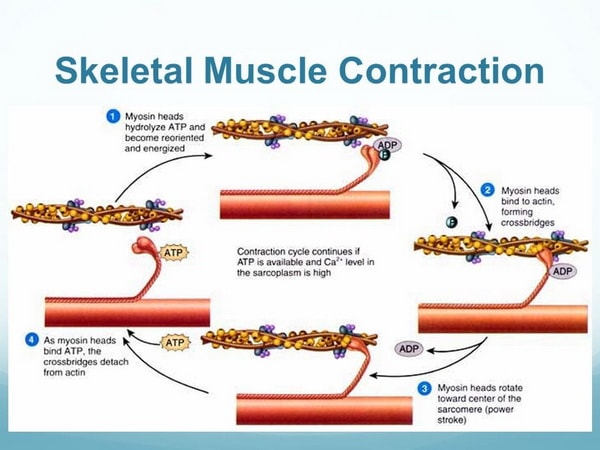
The ACTA1 protein is a key component in various structures. One is its involvement in the actin cytoskeleton, which is a network of actin and its binding proteins that work together with microtubules and intermediate filaments that regular functions like cell migration [4]. ACTA1 is also associated with the stress fiber, a contractile actin bundle of actin filaments made of short actin filaments with alternating polarities. The skeletal alpha-actin expression is induced by stimuli and conditions known to cause muscle formation. Since the ACTA1 gene is an isoform in adult skeletal muscle, it forms the core of sarcomere's thin filaments. These thin filaments are what interact with different proteins like myosin [5]. In order for muscle contractions to occur, the sarcomere must shorten. This is the result of myosin binding to actin which then leads to the movement of the filaments. When the muscles begin to shorten, myosin heads need to bind to actin to pull it in, however, this process requires energy in the form of ATP. Myosin has two binding sites one for actin and the other for ATP. When ATP binds the myosin is forced to release actin causing a detachment and the formation of ADP. This puts the myosin head in a high energy conformation state or a "cocked" position. The head goes through what is called a power stroke and afterward, ADP is released. Actin and myosin are bound together again and ATP can then rebind allowing for the continuation of the contraction cycle.
Structural highlights
The structure shown to the right is the crystal structure of the vitamin D-binding protein (shown in yellow) and its complex with skeletal actin (shown in blue). Under normal conditions, the macromolecule is present in a dimeric form. "A homeostatic mechanism, termed the actin-scavenger system, is responsible for the depolymerization and removal of actin from the circulation. During the first phase of this mechanism, gelsolin severs the actin filaments. In the second phase, the vitamin D-binding protein (DBP) traps the actin monomers, which accelerates their clearance." [6]. The contacts between actin and DBP are a combination of hydrophobic and electrostatic interactions including direct hydrogen bonds (a total of 10), two salt bridges (connecting actin residues Asp-288 and Lys-328 and DBP residues Arg-218 and Glu-143, respectively), and a large number of contacts mediated by solvent molecules. There are many molecules or ligands that facilitate specific processes with actin. One of the unique ligands is ATP. The binding of ATP, in this case, allows the ACTA1 gene to bind efficiently to DBP. The hydrolysis of ATP gives the actin the necessary energy to perform certain tasks and without it, actin will release the DBP. It is also noted that in this complex ATP is either blocked or slowed down dramatically. This observation may be an indication that during ATP hydrolysis actin undergoes certain conformational transitions that cannot take place when it is bound to certain proteins. Attached to the ATP molecule there is the metal ion, magnesium, bound to the nucleotide site.The secondary structure displays the positions of the alpha-helices and beta-strands. As seen the protein is mostly comprised of alpha-helices (shown in magenta) with the beta-sheets in minority (shown in yellow).
- ↑ Otterbein LR, Cosio C, Graceffa P, Dominguez R. Crystal structures of the vitamin D-binding protein and its complex with actin: structural basis of the actin-scavenger system. Proc Natl Acad Sci U S A. 2002 Jun 11;99(12):8003-8. Epub 2002 Jun 4. PMID:12048248 doi:https://dx.doi.org/10.1073/pnas.122126299
- ↑ Nowak KJ, Wattanasirichaigoon D, Goebel HH, Wilce M, Pelin K, Donner K, Jacob RL, Hubner C, Oexle K, Anderson JR, Verity CM, North KN, Iannaccone ST, Muller CR, Nurnberg P, Muntoni F, Sewry C, Hughes I, Sutphen R, Lacson AG, Swoboda KJ, Vigneron J, Wallgren-Pettersson C, Beggs AH, Laing NG. Mutations in the skeletal muscle alpha-actin gene in patients with actin myopathy and nemaline myopathy. Nat Genet. 1999 Oct;23(2):208-12. PMID:10508519 doi:10.1038/13837
- ↑ Laing NG, Clarke NF, Dye DE, Liyanage K, Walker KR, Kobayashi Y, Shimakawa S, Hagiwara T, Ouvrier R, Sparrow JC, Nishino I, North KN, Nonaka I. Actin mutations are one cause of congenital fibre type disproportion. Ann Neurol. 2004 Nov;56(5):689-94. PMID:15468086 doi:10.1002/ana.20260
- ↑ Ilkovski B, Nowak KJ, Domazetovska A, Maxwell AL, Clement S, Davies KE, Laing NG, North KN, Cooper ST. Evidence for a dominant-negative effect in ACTA1 nemaline myopathy caused by abnormal folding, aggregation and altered polymerization of mutant actin isoforms. Hum Mol Genet. 2004 Aug 15;13(16):1727-43. Epub 2004 Jun 15. PMID:15198992 doi:10.1093/hmg/ddh185
- ↑ Laing NG, Dye DE, Wallgren-Pettersson C, Richard G, Monnier N, Lillis S, Winder TL, Lochmuller H, Graziano C, Mitrani-Rosenbaum S, Twomey D, Sparrow JC, Beggs AH, Nowak KJ. Mutations and polymorphisms of the skeletal muscle alpha-actin gene (ACTA1). Hum Mutat. 2009 Sep;30(9):1267-77. doi: 10.1002/humu.21059. PMID:19562689 doi:https://dx.doi.org/10.1002/humu.21059
- ↑ Otterbein LR, Cosio C, Graceffa P, Dominguez R. Crystal structures of the vitamin D-binding protein and its complex with actin: structural basis of the actin-scavenger system. Proc Natl Acad Sci U S A. 2002 Jun 11;99(12):8003-8. Epub 2002 Jun 4. PMID:12048248 doi:https://dx.doi.org/10.1073/pnas.122126299
|

