Sandbox Home: Difference between revisions

From Proteopedia
Jump to navigationJump to search
Joel L. Sussman (talk | contribs)
No edit summary
Joel L. Sussman (talk | contribs)
No edit summary
Line 1: Line 1:
<style>
  #tableColumnsMainPage td { vertical-align: top !important; }
</style>
<table id="tableColumnsMainPage" style="width:100%; border:2px solid #ddd; border-collapse:collapse; table-layout:fixed;">
   <!-- HEADER -->
   <!-- HEADER -->

Revision as of 16:01, 30 September 2025

<style>

 #tableColumnsMainPage td { vertical-align: top !important; }

</style>

ISSN 2310-6301
     
       As life is more than 2D, Proteopedia helps to bridge the gap between 3D structure & function of biomacromolecules
     
     
       Proteopedia presents this information in a user-friendly way as a collaborative & free 3D-encyclopedia of proteins & other biomolecules.
     
Selected Research Pages In Journals Education
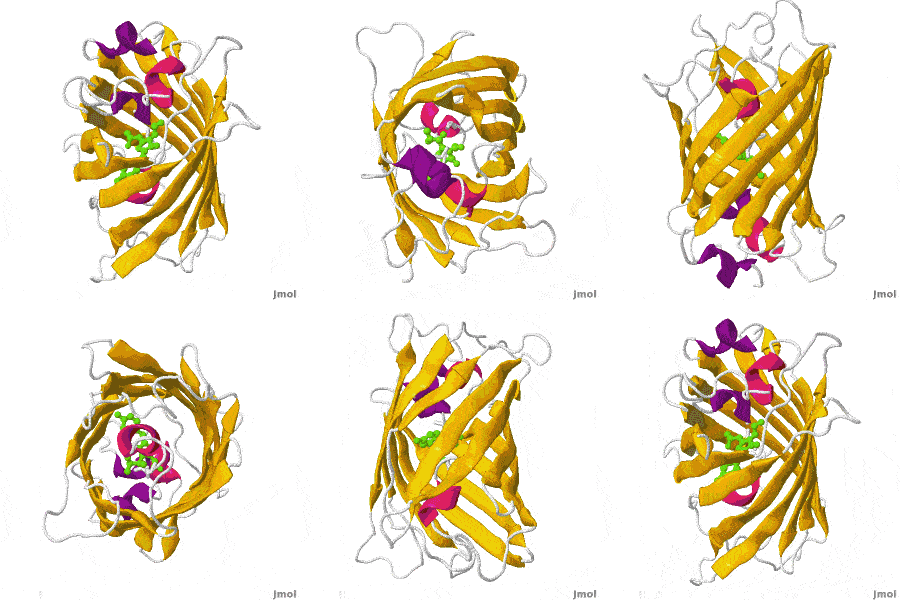
Green Fluorescent Protein

by Eran Hodis
Green fluorescent protein (GFP) is a bioluminescent polypeptide isolated from the jellyfish Aequorea victoria. GFP converts the blue chemiluminescence of aequorin into green fluorescent light. In the laboratory, GFP can be incorporated into a variety of biological systems in order to function as a marker protein. Since its discovery in 1962, GFP has become a significant contributor to the research of monitoring gene expression, localization, mobility, traffic, or interactions between various membrane and cytoplasmic proteins.

>>> Visit this page >>>

Interconversion of the specificities of human lysosomal enzymes associated with Fabry and Schindler diseases.

IB Tomasic, MC Metcalf, AI Guce, NE Clark, SC Garman. J. Biol. Chem. 2010 doi: 10.1074/jbc.M110.118588
The human lysosomal enzymes α-galactosidase and α-N-acetylgalactosaminidase share 46% amino acid sequence identity and have similar folds. Using a rational protein engineering approach, we interconverted the enzymatic specificity of α-GAL and α-NAGAL. The engineered α-GAL retains the antigenicity but has acquired the enzymatic specificity of α-NAGAL. Conversely, the engineered α-NAGAL retains the antigenicity but has acquired the enzymatic specificity of the α-GAL enzyme. Comparison of the crystal structures of the designed enzyme to the wild-type enzymes shows that active sites superimpose well, indicating success of the rational design. The designed enzymes might be useful as non-immunogenic alternatives in enzyme replacement therapy for treatment of lysosomal storage disorders such as Fabry disease.

>>> Visit this I3DC complement >>>

Touch-Sensitive Channel

Touching stretches cell membranes, opening mechanosensitive ion channels, leading to sensation by the nervous system. Pictured is the transmembrane region of a similar channel in bacteria. When closed, the narrow opening is lined by hydrophobic amino acid sidechains, making it non-conductive to ions.

>>> See more animations and explanation >>>

About Contact Hot News Table of Contents Structure Index Help