Main Page: Difference between revisions

From Proteopedia
Jump to navigationJump to search
Jaime Prilusky (talk | contribs)
No edit summary
Tag: Reverted
Jaime Prilusky (talk | contribs)
m Reverted edit by Jaime Prilusky (talk) to last revision by Angel Herraez
Tag: Rollback
Line 11: Line 11:
<th class="mainPageSectionC">Education</th>
</tr>
</tr>
<tr id="rowFeatured">
<tr id="rowFeatured"><td>{{Proteopedia:Featured SEL/{{#expr: {{#time:U}} mod {{Proteopedia:Number of SEL articles}}}}}}</td>
<td colspan="3">
<td>{{Proteopedia:Featured JRN/{{#expr: {{#time:U}} mod {{Proteopedia:Number of JRN articles}}}}}}</td>
<div class="proteopedia-featured-row">
<td>{{Proteopedia:Featured EDU/{{#expr: {{#time:U}} mod {{Proteopedia:Number of EDU articles}}}}}}</td>
  <div class="proteopedia-featured" data-featured-set="SEL"></div>
  <div class="proteopedia-featured" data-featured-set="JRN"></div>
  <div class="proteopedia-featured" data-featured-set="EDU"></div>
</div>
</td>
</tr>
</tr>
<tr id="rowClosingColors"><td class="mainPageSectionA">&nbsp;</td>

Revision as of 16:17, 1 October 2026

ISSN 2310-6301
As life is more than 2D, Proteopedia helps to bridge the gap between 3D structure and function of biomacromolecules.
Proteopedia presents this information in a user-friendly way as a collaborative & free 3D-encyclopedia of proteins & other biomolecules.
Selected Research Pages In Journals Education

Lifecycle of SARS-CoV-2

What happens if a SARS-CoV-2 coronavirus enters your lung? This molecular animation visualises how the virus particle can take over the host cell and turns it into a virus factory. Eventually, the host cell produces so many viral particles that it dies and releases numerous new virus particles. >>> Visit this page >>>

Geobacter pili: surprising function.

Y Gu, V Srikanth, AI Salazar-Morales, R Jain, JP O'Brien, SM Yi, RK Soni, FA Samatey, SE Yalcin, NS Malvankar. Nature 2021 doi: 10.1038/s41586-021-03857-w
Geobacter pili were long thought to be electrically conductive protein nanowires composed of PilA-N. Nanowires are crucial to the energy metabolism of bacteria flourishing in oxygen-deprived environments. To everyone's surprise, in 2019, the long-studied nanowires were found to be linear polymers of multi-heme cytochromes, not pili. The first cryo-EM structure of pili (2021) reveals a filament made of dimers of PilA-N and PilA-C, shown. Electrical conductivity of pili is much lower than that of cytochrome nanowires. Evidence suggests that PilA-NC filaments are periplasmic pseudopili crucial for exporting cytochrome nanowires onto the cell surface, rather than the pili serving as nanowires themselves.

>>> Visit I3DC Interactive Visualizations >>>

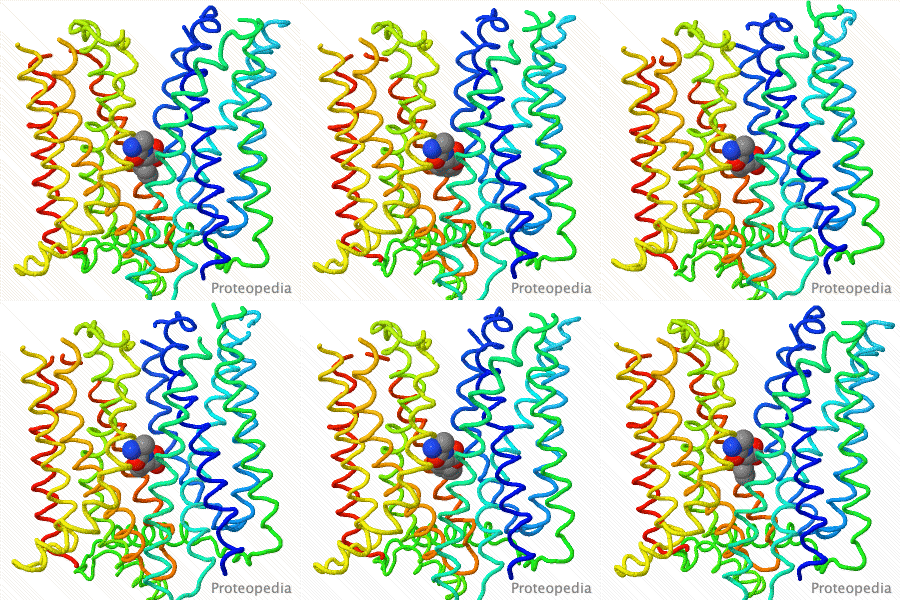
You Are What You Eat!

Above is an integral membrane protein that takes up, into your intestinal cells, orally consumed peptide nutrients and drugs. Its lumen-face (top) opens and binds peptide or drug (small solid object in the center), then closes, while its cytoplasmic face (bottom) opens to release its cargo into the intestinal cell, which passes it on to the blood circulation.

>>> See more animations and explanation >>>


How to add content to Proteopedia
Video Guides
Who knows ...

About Interactive 3D Complements - I3DCs
List of I3DCs
How to get an I3DC for your paper

Teaching strategies using Proteopedia
Examples of pages for teaching
How to add content to Proteopedia

Proteopedia Page Contributors and Editors (what is this?)

Jaime Prilusky, Joel L. Sussman, Angel Herraez