Human Prion Protein Dimer: Difference between revisions
| Line 98: | Line 98: | ||
The following interactions and residue switching portray possible catalytic sites: | The following interactions and residue switching portray possible catalytic sites: | ||
Residues 129, 200, and 164 to 170 are shown to exist right at the dimer interfaces | Residues 129, 200, and 164 to 170 are shown to exist right at the dimer interfaces. The location of these residues within the dimer indicates that their key operation is found somewhere in the dimerization process. <ref name="Lee">PMID:19927125</ref><ref name="Knaus">PMID:11524679</ref><ref name="Zhang">PMID:10954699</ref> | ||
Helix 1 (Ser 143−Tyr 157) exists at the <scene name='User:Erin_May/Sandbox_1/Nonpolar_at_dimer_interface/2'>dimer interface</scene>. Many nonpolar residues form Van der Waals attractions. Acidic and mostly negative residues are shown in blue. Basic and mostly positive residues are shown in red. The interactions between these also stabilize the dimer interface. | Helix 1 (Ser 143−Tyr 157) exists at the <scene name='User:Erin_May/Sandbox_1/Nonpolar_at_dimer_interface/2'>dimer interface</scene>. Many nonpolar residues form Van der Waals attractions. Acidic and mostly negative residues are shown in blue. Basic and mostly positive residues are shown in red. The interactions between these also stabilize the dimer interface. | ||
Revision as of 00:07, 28 November 2012
Prions as a disease causing agent


Prions are infectious or genetically coded misfolded proteins which act as templates upon which properly folded prion protein monomers can aggregate. Prions contain no nucleic acid such as other infectoius molecules or organisms. Human Prion Protein or Major Prion protein, exists as a normal constituent of human cells, found mostly in the brain[2] and is called PrPC.[3] PrPC is composed of mostly helix whereas the infectious form, PrPSc (also known as "scrapie" form), is composed of high percentage beta sheets.[3]
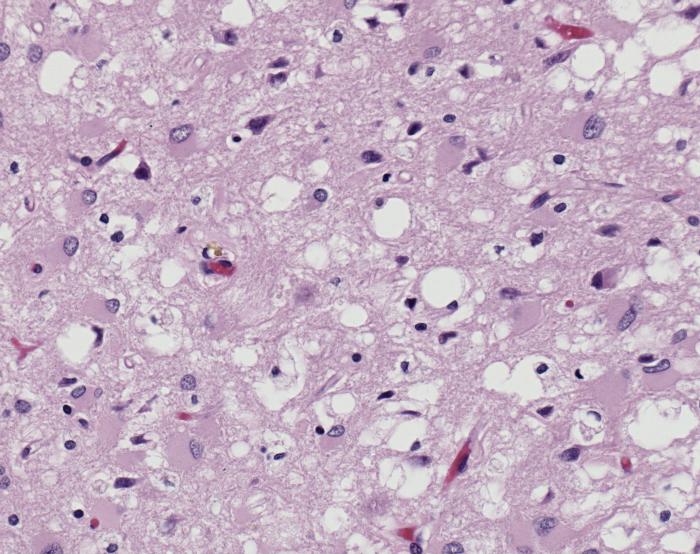
The diseases prions confer are neurodegenerative disorders which result from the large scale aggregation of these proteins. This "bubbles" of protein aggregates appear clear on a pictomicrograph and resemble a sponge. Bovine Spongiform Encephalopathy(BSE), or Mad Cow Disease, is a form of Transmissible Spongiform Encephalopathy caused by ingesting bovine prions. The first known cases of BSE occurred in the 1970's and have garnered a lot of media attention. Recently, feed bans in the United States and Canada have been adopted by the government in an attempt to stop the spread of BSE between cows. This bans the use of potential materials which would contain prion proteins, whether misfolded or wild-type. [4] For more information about the infections related to prions see Transmissible spongiform encephalopathy at Wikipedia.
Unfolding Mechanism
Currently, the mechanism by which a template prion unfolds the helices of a properly folded prion protein is unknown. Specific residues have been shown to either confer resistance or lend themselves to this unfolding.
PrPC natural monomer
| ||||||||||||

PrPSc
| ||||||||||||
Dimer Form
| ||||||||||||
Reference List
- ↑ Image of Creutzfeldt-Jakob positive brain tissue was obtained from The CDC's Public Health Image Library.
- ↑ Centers for Disease Control and Prevention: Prions. https://www.cdc.gov/ncidod/dvrd/prions/
- ↑ 3.0 3.1 Prusiner SB. Prions. Proc Natl Acad Sci U S A. 1998 Nov 10;95(23):13363-83. PMID:9811807
- ↑ Centers for Disease Control and Prevention: Bovine Spongiform Encephalopathy. https://www.cdc.gov/ncidod/dvrd/bse/index.htm
Proteopedia Page Contributors and Editors (what is this?)
Erin May, Michal Harel, Jaime Prilusky, Alexander Berchansky