Human Prion Protein Dimer: Difference between revisions
From Proteopedia
Jump to navigationJump to search
Michal Harel (talk | contribs) No edit summary |
No edit summary |
||
| Line 1: | Line 1: | ||
<StructureSection load='1qlx' size='450' side='right' caption='' scene=''> | |||
== Prions as a disease causing agent== | == Prions as a disease causing agent== | ||
| Line 9: | Line 10: | ||
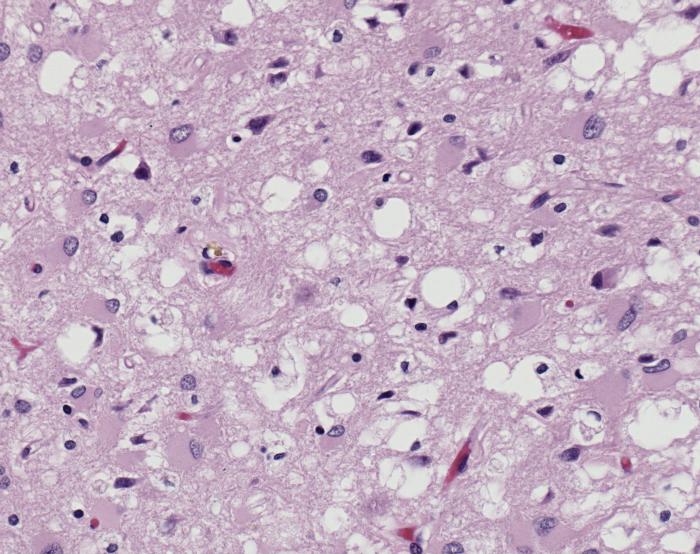
The diseases prions confer are neurodegenerative disorders which result from the large scale aggregation of these proteins. This "bubbles" of protein aggregates appear clear on a pictomicrograph and resemble a sponge. Bovine Spongiform Encephalopathy(BSE), or Mad Cow Disease, is a form of Transmissible Spongiform Encephalopathy caused by ingesting bovine prions. The first known cases of BSE occurred in the 1970's and have garnered a lot of media attention. Recently, feed bans in the United States and Canada have been adopted by the government in an attempt to stop the spread of BSE between cows. This bans the use of potential materials which would contain prion proteins, whether misfolded or wild-type. <ref>Centers for Disease Control and Prevention: Bovine Spongiform Encephalopathy. http://www.cdc.gov/ncidod/dvrd/bse/index.htm</ref> For more information about the infections related to prions see [http://en.wikipedia.org/wiki/Transmissible_spongiform_encephalopathy Transmissible spongiform encephalopathy at Wikipedia]. | The diseases prions confer are neurodegenerative disorders which result from the large scale aggregation of these proteins. This "bubbles" of protein aggregates appear clear on a pictomicrograph and resemble a sponge. Bovine Spongiform Encephalopathy(BSE), or Mad Cow Disease, is a form of Transmissible Spongiform Encephalopathy caused by ingesting bovine prions. The first known cases of BSE occurred in the 1970's and have garnered a lot of media attention. Recently, feed bans in the United States and Canada have been adopted by the government in an attempt to stop the spread of BSE between cows. This bans the use of potential materials which would contain prion proteins, whether misfolded or wild-type. <ref>Centers for Disease Control and Prevention: Bovine Spongiform Encephalopathy. http://www.cdc.gov/ncidod/dvrd/bse/index.htm</ref> For more information about the infections related to prions see [http://en.wikipedia.org/wiki/Transmissible_spongiform_encephalopathy Transmissible spongiform encephalopathy at Wikipedia]. | ||
== Unfolding Mechanism == | == Unfolding Mechanism == | ||
| Line 45: | Line 15: | ||
===PrP<sup>C</sup> natural monomer=== | ===PrP<sup>C</sup> natural monomer=== | ||
This monomeric structure is the form of Major Prion Protein as it appears in a non-diseased individual. The majority of this 3D structure is <scene name='User:Erin_May/Sandbox_1/Alpha_helices/1'>alpha helices</scene> and two small beta sheets. | This monomeric structure is the form of Major Prion Protein as it appears in a non-diseased individual. The majority of this 3D structure is <scene name='User:Erin_May/Sandbox_1/Alpha_helices/1'>alpha helices</scene> and two small beta sheets. | ||
Revision as of 09:50, 8 May 2013
| |||||||||||


PrPSc
| ||||||||||||
Dimer Form
| ||||||||||||
Reference List
Proteopedia Page Contributors and Editors (what is this?)
Erin May, Michal Harel, Jaime Prilusky, Alexander Berchansky