Human Prion Protein Dimer: Difference between revisions
From Proteopedia
Jump to navigationJump to search
No edit summary |
No edit summary |
||
| Line 2: | Line 2: | ||
== Prions as a disease causing agent== | == Prions as a disease causing agent== | ||
[[Image:1i4m.png| | [[Image:1i4m.png|left|150px|thumb|Human Prion Protein in dimer form [[1i4m]]]] | ||
{{clear}} | |||
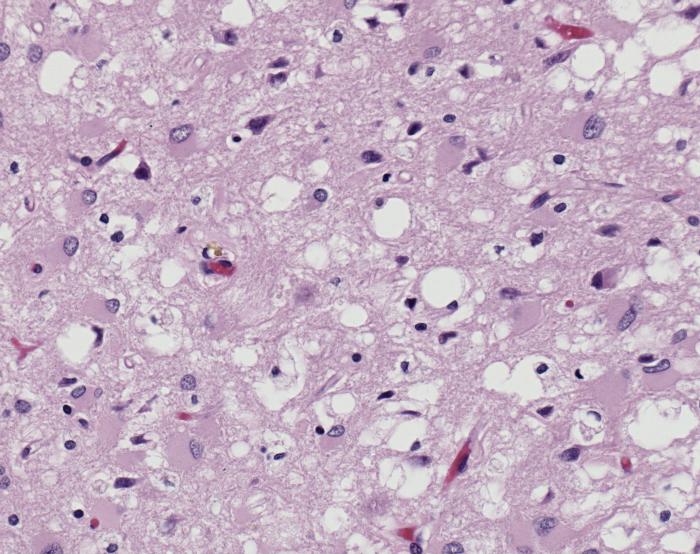
[[Image:10131_lores.jpg|left|300px|thumb|Pictomicrograph of Creutzfeldt-Jakob positive brain tissue|Caption: Holes in this sponge like brain tissue result from pockets of prion aggregation <ref>[http://phil.cdc.gov/PHIL_Images/10131/10131_lores.jpg Image of Creutzfeldt-Jakob positive brain tissue] was obtained from The CDC's Public Health Image Library.</ref>]] | |||
[[Image:10131_lores.jpg|left| | |||
[http://en.wikipedia.org/wiki/Prion Prions] are infectious or genetically coded misfolded proteins which act as templates upon which properly folded prion protein monomers can aggregate. Prions contain no nucleic acid such as other infectoius molecules or organisms. Human Prion Protein or Major Prion protein, exists as a normal constituent of human cells, found mostly in the brain<ref>Centers for Disease Control and Prevention: Prions. http://www.cdc.gov/ncidod/dvrd/prions/</ref> and is called PrP<sup>C</sup>.<ref name="Prusiner">PMID:9811807</ref> PrP<sup>C</sup> is composed of mostly helix whereas the infectious form, PrP<sup>Sc</sup> (also known as "scrapie" form), is composed of high percentage beta sheets.<ref name="Prusiner">PMID:9811807</ref> | [http://en.wikipedia.org/wiki/Prion Prions] are infectious or genetically coded misfolded proteins which act as templates upon which properly folded prion protein monomers can aggregate. Prions contain no nucleic acid such as other infectoius molecules or organisms. Human Prion Protein or Major Prion protein, exists as a normal constituent of human cells, found mostly in the brain<ref>Centers for Disease Control and Prevention: Prions. http://www.cdc.gov/ncidod/dvrd/prions/</ref> and is called PrP<sup>C</sup>.<ref name="Prusiner">PMID:9811807</ref> PrP<sup>C</sup> is composed of mostly helix whereas the infectious form, PrP<sup>Sc</sup> (also known as "scrapie" form), is composed of high percentage beta sheets.<ref name="Prusiner">PMID:9811807</ref> | ||
Revision as of 09:55, 8 May 2013
| |||||||||||


PrPSc
| ||||||||||||
Dimer Form
| ||||||||||||
Reference List
Proteopedia Page Contributors and Editors (what is this?)
Erin May, Michal Harel, Jaime Prilusky, Alexander Berchansky