Main Page: Difference between revisions

From Proteopedia
Jump to navigationJump to search
Joel L. Sussman (talk | contribs)
No edit summary
Joel L. Sussman (talk | contribs)
No edit summary
Line 45: Line 45:


<td style="padding: 10px;>
<p>[[I3DC|About Interactive 3D Complement]]</p>
<p>[[I3DC|About Interactive 3D Complements ('''I3DCs''')]]</p>
<p>[[Proteopedia:I3DC|List of Interactive 3D Complements('''I3DCs''')]]</p>
<p>[[Proteopedia:I3DC|List of I3DCs]]</p>
<p>[[How to get an I3DC for your paper]]</p>


</td>
</td>

Revision as of 09:53, 21 October 2018

ISSN 2310-6301

As life is more than 2D, Proteopedia helps to bridge the 3D relationships between function & structure of biomacromolecules


Selected Pages Art on Science Journals Education
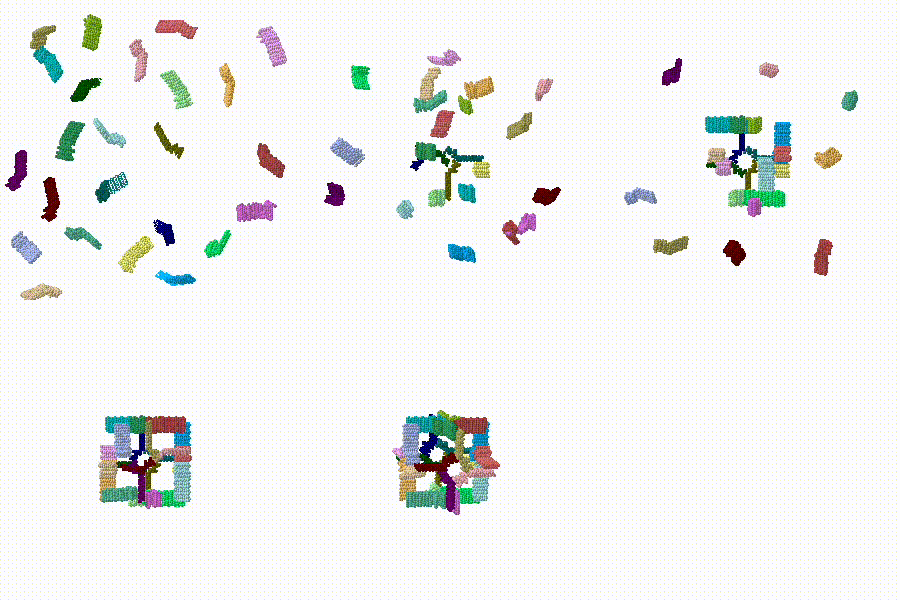
Self-assembling Nano-Cages

Huddy, Hsia, Kibler, Xu & 27 others in the Nobel Prize winning group of David Baker have designed standardized protein building blocks that self assemble into a wide range of nanostructures. The building blocks attach to each other at engineered sites and angles, and come in various sizes.

>>> Get a quick overview! >>>

Opening a Gate to Human Health

by Alice Clark (PDBe)
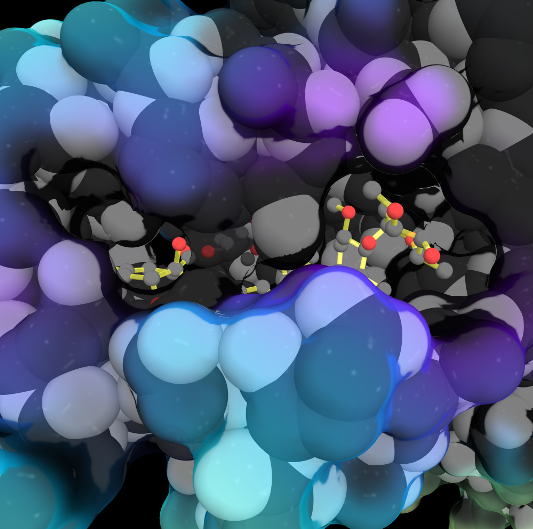
In the 1970s, an exciting discovery of a family of medicines was made by the Japanese scientist Satoshi Ōmura. One of these molecules, ivermectin, is shown in this artwork bound in the ligand binding pocket of the Farnesoid X receptor, a protein which helps regulate cholesterol in humans. This structure showed that ivermectin induced transcriptional activity of FXR and could be used to regulate metabolism.

>>> Visit this page >>>

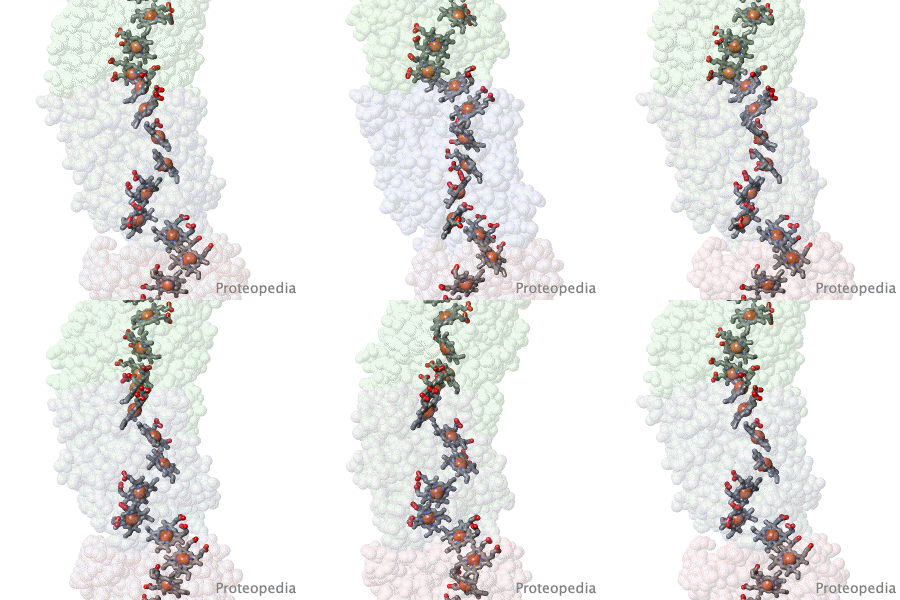
Geobacter nanowire structure surprise.

F Wang, Y Gu, JP O'Brien, SM Yi, SE Yalcin, V Srikanth, C Shen, D Vu, NL Ing, AI Hochbaum, EH Egelman, NS Malvankar. Cell 2019 doi: 10.1016/j.cell.2019.03.029
Bacteria living in anaerobic environments (no oxygen) need alternative electron acceptors in order to get energy from their food. An acceptor abundant in the earth's crust is red iron oxide ("rust"), which gets reduced to black iron oxide (magnetite). Many bacteria, such as Geobacter, get their metabolic energy by transferring electrons to acceptors that are multiple cell diameters distant, using protein nanowires. These were long thought to be pili. But when the structure of the nanowires was solved in 2019, to everyone's surprise, they turned out to be unprecedented linear polymers of multi-heme cytochromes. The hemes form an electrically conductive chain in the cores of these nanowires.

>>> Visit I3DC Interactive Visualizations >>>

Polio is still here!
Polio vaccines have been available since the 1950s, but the challenges of vaccination in remote areas of Afghanistan and Pakistan have prevented worldwide eradication. In 2022, polio was found circulating in parts of New York State, USA. The polio virus has a small RNA genome enclosed in an icosahedral capsid composed of several proteins, shown cut in half. The structures of virus capsids can be explored using free FirstGlance in Jmol.

>>> Visit I3DC Interactive Visualizations >>>

How to add content to Proteopedia

Video Guides

Who knows ...

List of Art on Science pages in Proteopedia

About Interactive 3D Complements (I3DCs)

List of I3DCs

How to get an I3DC for your paper

Teaching Strategies Using Proteopedia

Examples of Pages for Teaching

How to add content to Proteopedia

About Contact Table of Contents Structure Index Help

Proteopedia Page Contributors and Editors (what is this?)

Jaime Prilusky, Joel L. Sussman, Angel Herraez