Main Page: Difference between revisions

From Proteopedia
Jump to navigationJump to search
Joel L. Sussman (talk | contribs)
No edit summary
Joel L. Sussman (talk | contribs)
No edit summary
Line 32: Line 32:


<tr style="font-size: 1.2em; text-align: center;">
<tr style="font-size: 1.0em; text-align: center;">


<td style="padding: 5px;>
<td style="padding: 10px;>
<p>[[Help:Contents#For_authors:_contributing_content|How to add content to Proteopedia]]</p>
<p>[[Proteopedia:Video_Guide|Video Guides]]</p>

Revision as of 10:01, 21 October 2018

ISSN 2310-6301

As life is more than 2D, Proteopedia helps to bridge the 3D relationships between function & structure of biomacromolecules


Selected Pages Art on Science Journals Education
Coronavirus COVID-19

A novel coronavirus was found to be the cause of a respiratory illness first detected in Wuhan, China in 2019. 3D structural studies are aiding scientists to understand how the coronavirus infects humans and helping to find new ways to treat the viral spread (video by Fusion Animation).

>>> Visit this page >>>

Opening a Gate to Human Health

by Alice Clark (PDBe)
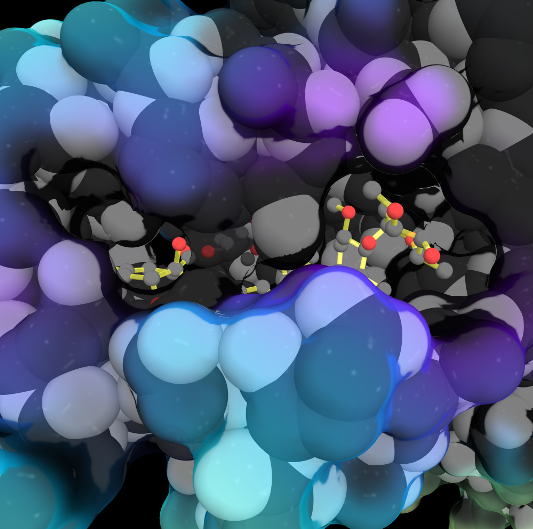
In the 1970s, an exciting discovery of a family of medicines was made by the Japanese scientist Satoshi Ōmura. One of these molecules, ivermectin, is shown in this artwork bound in the ligand binding pocket of the Farnesoid X receptor, a protein which helps regulate cholesterol in humans. This structure showed that ivermectin induced transcriptional activity of FXR and could be used to regulate metabolism.

>>> Visit this page >>>

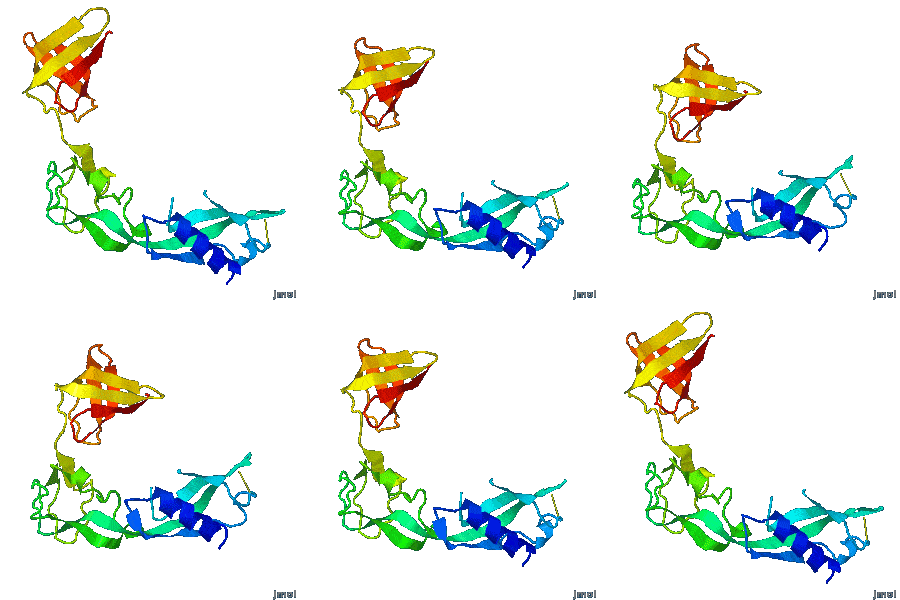
Structural flexibility of the periplasmic protein, FlgA, regulates flagellar P-ring assembly in Salmonella enterica.

H Matsunami, YH Yoon, VA Meshcheryakov, K Namba, FA Samatey. Scientific Reports 2016 doi: 10.1038/srep27399
A periplasmic flagellar chaperone protein, FlgA, is required for P-ring assembly in bacterial flagella of taxa such as Salmonella enterica or Escherichia coli. Here we present the open and closed crystal structures of FlgA from Salmonella enterica serovar Typhimurium, grown under different crystallization conditions. An intramolecular disulfide cross-linked form of FlgA caused a dominant negative effect on motility of the wild-type strain.

>>> Visit this I3DC complement >>>

Polio is still here!
Polio vaccines have been available since the 1950s, but the challenges of vaccination in remote areas of Afghanistan and Pakistan have prevented worldwide eradication. In 2022, polio was found circulating in parts of New York State, USA. The polio virus has a small RNA genome enclosed in an icosahedral capsid composed of several proteins, shown cut in half. The structures of virus capsids can be explored using free FirstGlance in Jmol.

>>> Visit I3DC Interactive Visualizations >>>

How to add content to Proteopedia

Video Guides

Who knows ...

List of Art on Science pages

About Interactive 3D Complements - I3DCs

List of I3DCs

How to get an I3DC for your paper

Teaching strategies using Proteopedia

Examples of pages for teaching

How to add content to Proteopedia

About Contact Table of Contents Structure Index Help

Proteopedia Page Contributors and Editors (what is this?)

Jaime Prilusky, Joel L. Sussman, Angel Herraez