Neurotrophin-4 (NT-4) is a neuronal growth factor that influences nerve cell proliferation through selective and non-covalent interactions with the nerve growth factor receptor.
Function
NT-4 functions as a growth factor in many biological pathways and processes to induce neuronal proliferation.
Biological Processes
Positive regulation of neurotrophin TRK receptor signaling pathway:
NT-4 functions as a ligand when binding to neurotrophin receptor tyrosine kinase NTRK2. Auto-phosphorylated NTRK2 dimers that are formed on tyrosine residues in receptor tail as a result of NT-4 binding.
Neuron projection morphogenesis:
Generating projection structures of a neuron,.
Ganglion mother cell fate determination, epidermis development, innervation
Nerve invading tissue and coming out
Disease
NT-4, along with other growth factors including neurotrophin-3 (NT-3), brain-derived neurotrophic factor (BDNF), and nerve growth factor (NGF) have all shown to be essential for survival of neurons. [1], [2] These growth factors have been associated with parts of the cerebrum including the frontal lobe and limbic system because of their involvement in neurological processes like behavior, learning, and memory. [3]
Relevance
Structural highlights
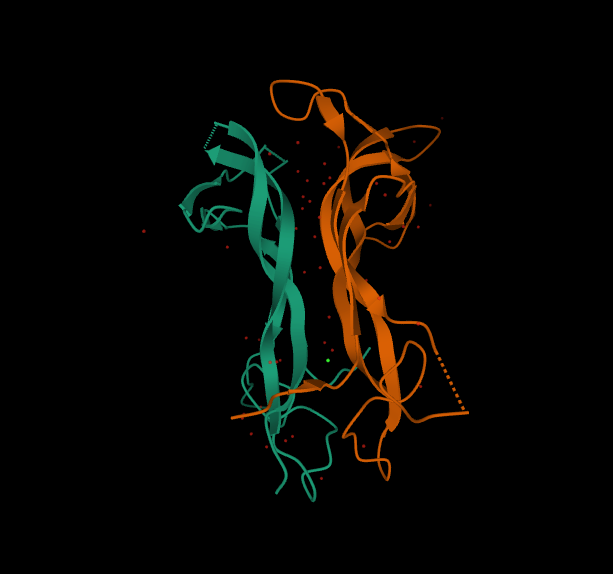
This is a sample scene created with SAT to color by Group, and another to make a transparent representation of the protein. You can make your own scenes on SAT starting from scratch or loading and editing one of these sample scenes.
- ↑ Robinson RC, Radziejewski C, Spraggon G, Greenwald J, Kostura MR, Burtnick LD, Stuart DI, Choe S, Jones EY. The structures of the neurotrophin 4 homodimer and the brain-derived neurotrophic factor/neurotrophin 4 heterodimer reveal a common Trk-binding site. Protein Sci. 1999 Dec;8(12):2589-97. PMID:10631974
- ↑ 16411893
- ↑ Chao MV, Rajagopal R, Lee FS. Neurotrophin signalling in health and disease. Clin Sci (Lond). 2006 Feb;110(2):167-73. doi: 10.1042/CS20050163. PMID:16411893 doi:https://dx.doi.org/10.1042/CS20050163

