| Neurotrophin-4 (NT-4) belongs to a group of neuronal growth factors that influence nerve cell proliferation through selective and non-covalent interactions with the nerve growth factor receptor. [1]
Function
NT-4 functions as a growth factor in many biological pathways and processes to induce neuronal proliferation. [2]
Biological Processes
Positive regulation of neurotrophin TRK receptor signaling pathway:
NT-4 functions as a ligand when binding to neurotrophin receptor tyrosine kinase NTRK2. Auto-phosphorylated NTRK2 dimers that are formed on tyrosine residues in receptor tail as a result of NT-4 binding.
Adult locomotory behavior [3], neuron projection morphogenesis:
generating projection structures of a neuron, [4]
ganglion mother cell fate determination,[5] epidermis development, [6] innervation, long term memory, [7] chemical synaptic transmission modulation and nerve development, [8] mechanoreceptor differentiation, negative regulation of neuron apoptotic process, and positive regulation of peptidyl-serine phosphorylation, [9] nerve growth signaling pathway, [10] and sensory organ boundary specification (taste bud development). [11]
Disease
NT-4, along with other growth factors including neurotrophin-3 (NT-3), brain-derived neurotrophic factor (BDNF), and nerve growth factor (NGF) have all shown to be essential for survival of neurons. [12] [13] These growth factors have been associated with parts of the cerebrum including the frontal lobe and limbic system because of their involvement in neurological processes like behavior, learning, and memory. [14]
Relevance
Structural highlights
N to C sequence
Copy and paste the following line where you want the scene link to appear (scroll down if needed) and edit the TextToBeDisplayed:
Temperature Value
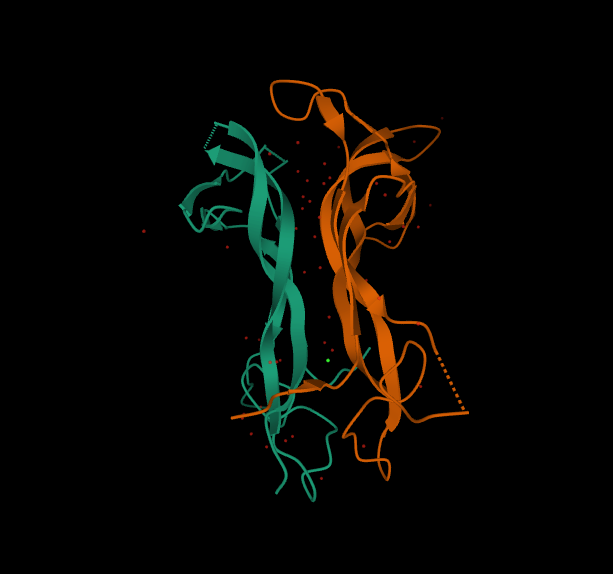 
This is a sample scene created with SAT to color by Group, and another to make a transparent representation of the protein. You can make your own scenes on SAT starting from scratch or loading and editing one of these sample scenes.
- ↑ Chao MV, Rajagopal R, Lee FS. Neurotrophin signalling in health and disease. Clin Sci (Lond). 2006 Feb;110(2):167-73. doi: 10.1042/CS20050163. PMID:16411893 doi:https://dx.doi.org/10.1042/CS20050163
- ↑ Robinson RC, Radziejewski C, Spraggon G, Greenwald J, Kostura MR, Burtnick LD, Stuart DI, Choe S, Jones EY. The structures of the neurotrophin 4 homodimer and the brain-derived neurotrophic factor/neurotrophin 4 heterodimer reveal a common Trk-binding site. Protein Sci. 1999 Dec;8(12):2589-97. PMID:10631974
- ↑ Liebl DJ, Klesse LJ, Tessarollo L, Wohlman T, Parada LF. Loss of brain-derived neurotrophic factor-dependent neural crest-derived sensory neurons in neurotrophin-4 mutant mice. Proc Natl Acad Sci U S A. 2000 Feb 29;97(5):2297-302. doi:, 10.1073/pnas.040562597. PMID:10681461 doi:https://dx.doi.org/10.1073/pnas.040562597
- ↑ Gaudet P, Livstone MS, Lewis SE, Thomas PD. Phylogenetic-based propagation of functional annotations within the Gene Ontology consortium. Brief Bioinform. 2011 Sep;12(5):449-62. doi: 10.1093/bib/bbr042. Epub 2011 Aug, 27. PMID:21873635 doi:https://dx.doi.org/10.1093/bib/bbr042
- ↑ Liebl DJ, Klesse LJ, Tessarollo L, Wohlman T, Parada LF. Loss of brain-derived neurotrophic factor-dependent neural crest-derived sensory neurons in neurotrophin-4 mutant mice. Proc Natl Acad Sci U S A. 2000 Feb 29;97(5):2297-302. doi:, 10.1073/pnas.040562597. PMID:10681461 doi:https://dx.doi.org/10.1073/pnas.040562597
- ↑ Botchkarev VA, Botchkareva NV, Welker P, Metz M, Lewin GR, Subramaniam A, Bulfone-Paus S, Hagen E, Braun A, Lommatzsch M, Renz H, Paus AR. A new role for neurotrophins: involvement of brain-derived neurotrophic factor and neurotrophin-4 in hair cycle control. FASEB J. 1999 Feb;13(2):395-410. doi: 10.1096/fasebj.13.2.395. PMID:9973328 doi:https://dx.doi.org/10.1096/fasebj.13.2.395
- ↑ Xie CW, Sayah D, Chen QS, Wei WZ, Smith D, Liu X. Deficient long-term memory and long-lasting long-term potentiation in mice with a targeted deletion of neurotrophin-4 gene. Proc Natl Acad Sci U S A. 2000 Jul 5;97(14):8116-21. doi: 10.1073/pnas.140204597. PMID:10869436 doi:https://dx.doi.org/10.1073/pnas.140204597
- ↑ Gaudet P, Livstone MS, Lewis SE, Thomas PD. Phylogenetic-based propagation of functional annotations within the Gene Ontology consortium. Brief Bioinform. 2011 Sep;12(5):449-62. doi: 10.1093/bib/bbr042. Epub 2011 Aug, 27. PMID:21873635 doi:https://dx.doi.org/10.1093/bib/bbr042
- ↑ Gaudet P, Livstone MS, Lewis SE, Thomas PD. Phylogenetic-based propagation of functional annotations within the Gene Ontology consortium. Brief Bioinform. 2011 Sep;12(5):449-62. doi: 10.1093/bib/bbr042. Epub 2011 Aug, 27. PMID:21873635 doi:https://dx.doi.org/10.1093/bib/bbr042
- ↑ Sofroniew MV, Howe CL, Mobley WC. Nerve growth factor signaling, neuroprotection, and neural repair. Annu Rev Neurosci. 2001;24:1217-81. doi: 10.1146/annurev.neuro.24.1.1217. PMID:11520933 doi:https://dx.doi.org/10.1146/annurev.neuro.24.1.1217
- ↑ Liebl DJ, Mbiene JP, Parada LF. NT4/5 mutant mice have deficiency in gustatory papillae and taste bud formation. Dev Biol. 1999 Sep 15;213(2):378-89. doi: 10.1006/dbio.1999.9385. PMID:10479455 doi:https://dx.doi.org/10.1006/dbio.1999.9385
- ↑ Robinson RC, Radziejewski C, Spraggon G, Greenwald J, Kostura MR, Burtnick LD, Stuart DI, Choe S, Jones EY. The structures of the neurotrophin 4 homodimer and the brain-derived neurotrophic factor/neurotrophin 4 heterodimer reveal a common Trk-binding site. Protein Sci. 1999 Dec;8(12):2589-97. PMID:10631974
- ↑ Chao MV, Rajagopal R, Lee FS. Neurotrophin signalling in health and disease. Clin Sci (Lond). 2006 Feb;110(2):167-73. doi: 10.1042/CS20050163. PMID:16411893 doi:https://dx.doi.org/10.1042/CS20050163
- ↑ Chao MV, Rajagopal R, Lee FS. Neurotrophin signalling in health and disease. Clin Sci (Lond). 2006 Feb;110(2):167-73. doi: 10.1042/CS20050163. PMID:16411893 doi:https://dx.doi.org/10.1042/CS20050163
|


