| Neurotrophin-4 (NT-4) belongs to a group of nerve growth factors that influence nerve cell proliferation through selective and non-covalent interactions with the nerve growth factor receptor. [1]
Function
NT-4 functions as a growth factor in many biological pathways and processes to induce neuronal proliferation. [2]
Biological Processes
Positive regulation of neurotrophin TRK receptor signaling pathway:
NT-4 functions as a ligand when binding to neurotrophin receptor tyrosine kinase NTRK2. Auto-phosphorylated NTRK2 dimers that are formed on tyrosine residues in receptor tail as a result of NT-4 binding.
Adult locomotory behavior [3], neuron projection morphogenesis:
generating projection structures of a neuron, [4]
ganglion mother cell fate determination,[5] epidermis development, [6] innervation, long term memory, [7] chemical synaptic transmission modulation and nerve development, [8] mechanoreceptor differentiation, negative regulation of neuron apoptotic process, and positive regulation of peptidyl-serine phosphorylation, [9] nerve growth signaling pathway, [10] and sensory organ boundary specification (taste bud development). [11]
Disease
NT-4, along with other growth factors including neurotrophin-3 (NT-3), brain-derived neurotrophic factor (TextToBeDisplayed), and nerve growth factor (NGF) have all shown to be essential for survival of neurons. [12] [13] These growth factors have been associated with parts of the cerebrum including the frontal lobe and limbic system because of their involvement in neurological processes like behavior, learning, and memory. [14] Availability and binding affinity are two factors that contribute to development of Alzheimer's disease and Huntington's disease, as well as neurodegenerative and psychiatric disorders. [15] Both increased and decreased levels of NT-4 are associated with various disease states that effect mental development and decline. Serum concentration levels of NT-4 and BDNF were found to be higher in patients with autism and in patients with mental retardation [16] Defects or mutations in NT-4 has been associated with development of glaucoma.
Relevance
NT-4 is essential for neuron survival and proliferation throughout ones life span so maintaining proper amounts in the body is needed to stay healthy. Neuron growth factors are currently being used as biomarkers to study the relationship between them and various mental disease states including depression, schizophrenia, autism, Alzheimer's and Huntington's disease. Knowing the cause of variance in these levels is key for prevention of certain neurological disorders.
Depletion and/or unavailable receptor binding sites are also being studied to further understand these mechanisms.
Structural highlights
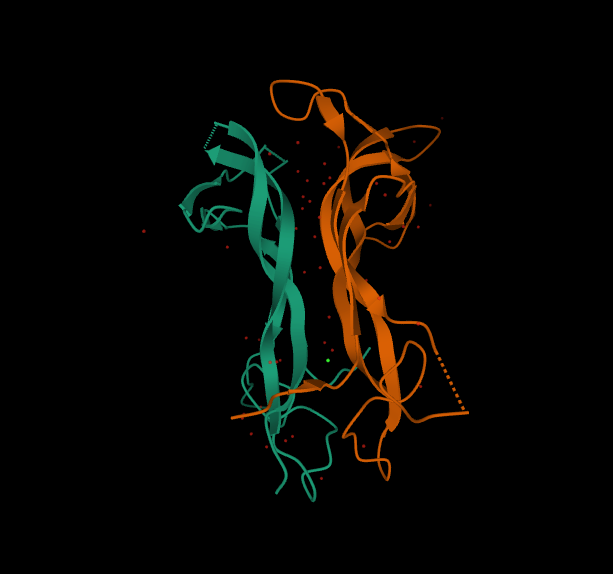
NT-4 is a homodimer; Its structure includes 2 Neurotrophin-4 factors bound with a chloride ion. NT-4 is 130 amino acids in length. This chloride ion is a ligand that binds to nerve growth factor receptors.
N to C sequence
Copy and paste the following line where you want the scene link to appear (scroll down if needed) and edit the TextToBeDisplayed:
Temperature Value
- ↑ Chao MV, Rajagopal R, Lee FS. Neurotrophin signalling in health and disease. Clin Sci (Lond). 2006 Feb;110(2):167-73. doi: 10.1042/CS20050163. PMID:16411893 doi:https://dx.doi.org/10.1042/CS20050163
- ↑ Robinson RC, Radziejewski C, Spraggon G, Greenwald J, Kostura MR, Burtnick LD, Stuart DI, Choe S, Jones EY. The structures of the neurotrophin 4 homodimer and the brain-derived neurotrophic factor/neurotrophin 4 heterodimer reveal a common Trk-binding site. Protein Sci. 1999 Dec;8(12):2589-97. PMID:10631974
- ↑ Liebl DJ, Klesse LJ, Tessarollo L, Wohlman T, Parada LF. Loss of brain-derived neurotrophic factor-dependent neural crest-derived sensory neurons in neurotrophin-4 mutant mice. Proc Natl Acad Sci U S A. 2000 Feb 29;97(5):2297-302. doi:, 10.1073/pnas.040562597. PMID:10681461 doi:https://dx.doi.org/10.1073/pnas.040562597
- ↑ Gaudet P, Livstone MS, Lewis SE, Thomas PD. Phylogenetic-based propagation of functional annotations within the Gene Ontology consortium. Brief Bioinform. 2011 Sep;12(5):449-62. doi: 10.1093/bib/bbr042. Epub 2011 Aug, 27. PMID:21873635 doi:https://dx.doi.org/10.1093/bib/bbr042
- ↑ Liebl DJ, Klesse LJ, Tessarollo L, Wohlman T, Parada LF. Loss of brain-derived neurotrophic factor-dependent neural crest-derived sensory neurons in neurotrophin-4 mutant mice. Proc Natl Acad Sci U S A. 2000 Feb 29;97(5):2297-302. doi:, 10.1073/pnas.040562597. PMID:10681461 doi:https://dx.doi.org/10.1073/pnas.040562597
- ↑ Botchkarev VA, Botchkareva NV, Welker P, Metz M, Lewin GR, Subramaniam A, Bulfone-Paus S, Hagen E, Braun A, Lommatzsch M, Renz H, Paus AR. A new role for neurotrophins: involvement of brain-derived neurotrophic factor and neurotrophin-4 in hair cycle control. FASEB J. 1999 Feb;13(2):395-410. doi: 10.1096/fasebj.13.2.395. PMID:9973328 doi:https://dx.doi.org/10.1096/fasebj.13.2.395
- ↑ Xie CW, Sayah D, Chen QS, Wei WZ, Smith D, Liu X. Deficient long-term memory and long-lasting long-term potentiation in mice with a targeted deletion of neurotrophin-4 gene. Proc Natl Acad Sci U S A. 2000 Jul 5;97(14):8116-21. doi: 10.1073/pnas.140204597. PMID:10869436 doi:https://dx.doi.org/10.1073/pnas.140204597
- ↑ Gaudet P, Livstone MS, Lewis SE, Thomas PD. Phylogenetic-based propagation of functional annotations within the Gene Ontology consortium. Brief Bioinform. 2011 Sep;12(5):449-62. doi: 10.1093/bib/bbr042. Epub 2011 Aug, 27. PMID:21873635 doi:https://dx.doi.org/10.1093/bib/bbr042
- ↑ Gaudet P, Livstone MS, Lewis SE, Thomas PD. Phylogenetic-based propagation of functional annotations within the Gene Ontology consortium. Brief Bioinform. 2011 Sep;12(5):449-62. doi: 10.1093/bib/bbr042. Epub 2011 Aug, 27. PMID:21873635 doi:https://dx.doi.org/10.1093/bib/bbr042
- ↑ Sofroniew MV, Howe CL, Mobley WC. Nerve growth factor signaling, neuroprotection, and neural repair. Annu Rev Neurosci. 2001;24:1217-81. doi: 10.1146/annurev.neuro.24.1.1217. PMID:11520933 doi:https://dx.doi.org/10.1146/annurev.neuro.24.1.1217
- ↑ Liebl DJ, Mbiene JP, Parada LF. NT4/5 mutant mice have deficiency in gustatory papillae and taste bud formation. Dev Biol. 1999 Sep 15;213(2):378-89. doi: 10.1006/dbio.1999.9385. PMID:10479455 doi:https://dx.doi.org/10.1006/dbio.1999.9385
- ↑ Robinson RC, Radziejewski C, Spraggon G, Greenwald J, Kostura MR, Burtnick LD, Stuart DI, Choe S, Jones EY. The structures of the neurotrophin 4 homodimer and the brain-derived neurotrophic factor/neurotrophin 4 heterodimer reveal a common Trk-binding site. Protein Sci. 1999 Dec;8(12):2589-97. PMID:10631974
- ↑ Chao MV, Rajagopal R, Lee FS. Neurotrophin signalling in health and disease. Clin Sci (Lond). 2006 Feb;110(2):167-73. doi: 10.1042/CS20050163. PMID:16411893 doi:https://dx.doi.org/10.1042/CS20050163
- ↑ Chao MV, Rajagopal R, Lee FS. Neurotrophin signalling in health and disease. Clin Sci (Lond). 2006 Feb;110(2):167-73. doi: 10.1042/CS20050163. PMID:16411893 doi:https://dx.doi.org/10.1042/CS20050163
- ↑ Chao MV, Rajagopal R, Lee FS. Neurotrophin signalling in health and disease. Clin Sci (Lond). 2006 Feb;110(2):167-73. doi: 10.1042/CS20050163. PMID:16411893 doi:https://dx.doi.org/10.1042/CS20050163
- ↑ Serum neurotrophin concentrations in autism and mental retardation: a pilot study
Miyazaki, Kaoru et al.
Brain and Development, Volume 26, Issue 5, 292 - 295
|


