Protease activity
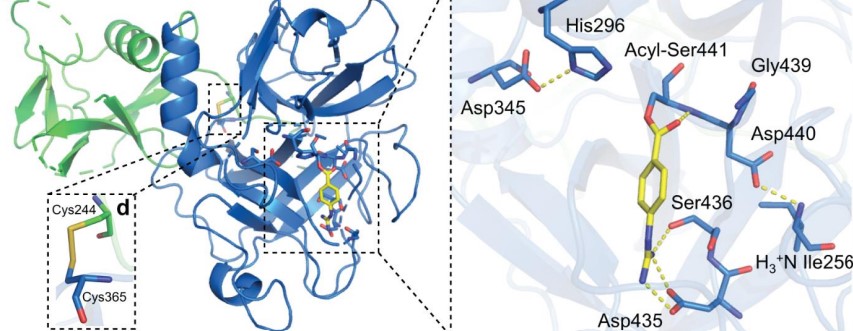
TMPRSS2, as a serine protease, cleaves peptide bonds present after positively charged residues (lysine or arginine). The main player in the catalytic mechanism is the catalytic triad formed by His296, Asp345, and Ser441. This three aminoacids are located in the active site of the enzyme. [1]
The substrate specificity is achieved with the presence of a negatively charged Asp residue at the bottom of a cavity usually indicated as “S1 specificity pocket”. [2]
General function
In terms of normal function, TMPRSS2 has
been associated with physiological and pathological processes such as digestion, tissue remodelling, blood coagulation, fertility, inflammatory
responses, tumour cell invasion, apoptosis and
pain. [3]
Prostate cancer
Prostate cancer (PC) is the most common form of cancer found in American men and the second leading cause of cancer death. [4] This means that approximately 28.5% of cancers and 3.5% of cancer related deaths in men are due to PC.
The most prevalent chromosomal aberration causing this pathology is the fusion of the the promoter of transmembrane protease serine 2 (TMPRSS2) gene and the coding sequence of the erythroblastosis virus E26 (Ets) gene family members. [5] Ets family members are oncogenic transcription factors. [6] Therefore, the fusion of these genes leads to the production of Ets transcription factors under the control of the androgen sensitive promoter elements of TMPRSS2. Specifically, the TMPRSS2-ERG fusion has been identified in approximately 50% of PC cases. [7]
This mutation occurs through chromosomal translocation or intergenic deletion, with both genes on the same arm of chromosome 21, and results in overexpression of chimeric mRNA of ERG in response to androgens. There is impairment of apoptosis in TMPRSS2-ERG positive cancer cells, possibly due to disruption of the intracellular death domain or decoy receptors. [8]
The high prevalence of these gene fusions, in particular TMPRSS2-ERG, makes them attractive as potential diagnostic and prognostic indicators, as well as making them a potential target for tailored therapies.
Viral entry
TMPRSS2 facilitates the entry of viruses into host cells by proteolytically cleaving and activating viral envelope glycoproteins. As human TMPRSS2 is expressed in cells of the respiratory tracts, in addition to the epithelia of the gastrointestinal and urogenital systems, it mediates the entry of several viruses related to respiratory diseases into the host cells, including Influenza virus and the human coronaviruses HCoV-229E, MERS-CoV, SARS-CoV and SARS-CoV-2 (COVID-19 virus).
SARS-CoV-2
SARS-CoV-2 entry is achieved by a receptor-mediated endocytosis pathway in which the spike (S) glycoprotein, located on the outer envelope of the virus, interacts with the host angiotensin-converting enzyme 2 (ACE2), a receptor located in the surface of host cells, which allows the virus to infect cells. Prior to this interaction, S protein is needed to be cleaved by different protease enzymes (furins, cathepsins, serine proteases). In this respect, cleavage of S protein by TMPRSS2 is preferred for Coronaviridae family infection over other proteases, such as the endosomal cathepsins.
Structure
Gene
The TMPRSS2 gene resides on chromosome 21 at the band 21q22.3, extends aproximately 43.59 kb and is split into 14 exons.
This gene is conserved in a wide variety of animals, such as chimpanzee, Rhesus monkey, dog, cow, mouse, rat, chicken, zebrafish, Caenorhabditis elegans and frog.
This gene presents two alternative splicing variants resulting in a 3.25 kb and 3.21 kb transcripts, respectively.
Protein
TMPRSS2 is a 492 amino acid single-pass type II membrane protein. This protein is defined by the presence of an N-terminal cytoplasmic domain, a transmembrane helical domain, and three extracellular domains: [9]
- Low-density lipoprotein (LDL)-receptor class A domain: which forms a binding site for calcium
- Scavenger receptor cysteine-rich domain (SRCR)
- Peptidase S1 domain, also known as serine protease domain (SPD)

Expression
Pharmacological therapeutic approaches
Nafamostat mesylate
Nafamostat mesylate (FUT-175; CAS number: 81525-10-2) is an artificial serine protease inhibitor clinically approved in Japan for the treatment of acute pancreatitis, intravascular coagulation dissemination, and extracorporeal circulation antioxidation. [10]
This drug is a competitive inhibitor of the binding active site, as well as Camostat. Both are reactive esters that form the same slowly-reversible phenylguanidino covalent complex with the catalytic serine (Ser441) residue of trypsin-like serine proteases.[11]
Nafamostat demonstrated enhanced potency over camostat with IC50 values of (1.7±0.2) and (17±4) nM, respectively.
Although nafamostat potently neutralizes TMPRSS2 activity, it is non-selective and disables trypsin-like serine proteases involved in coagulation such as plasmin, FXa, and FXIIa, as well as other TTSPs through its generic arginine-like engagement with the S1 subsite.[12][13]
Also it requires continuous intravenous infusion to approach therapeutic concentrations for COVID-19 owing to its short biological half-life of 8 minutes.
Camostat mesylate
Bromhexine
Repurposing of the mucolytic agent called bromhexine, a TMPRSS2 inhibitor, has been also proposed for COVID-19 therapy.[14]
Peptidomimetics
Transcriptional inhibition
Transcriptional inhibition of TMPRSS2 has been proposed as a new therapeutic option.
As TMPRSS2 expression seems to be modulated by estrogens and androgens, data suggest that the activation of estrogen pathways or inhibition of androgen pathways may be a new target for therapeutic clinical intervention for symptom amelioration in COVID-19 patients. [15]
Using computational and experimental methods, estrogen and androgen-related compounds such as genistein, estradiol, and enzatulamide have been shown to reduce TMPRSS2 expression.

Structural highlights
This is a sample scene created with SAT to color by Group, and another to make a transparent representation of the protein. You can make your own scenes on SAT starting from scratch or loading and editing one of these sample scenes.
- ↑ Evnin LB, Vasquez JR, Craik CS. Substrate specificity of trypsin investigated by using a genetic selection. Proc Natl Acad Sci U S A. 1990 Sep;87(17):6659-63. doi: 10.1073/pnas.87.17.6659. PMID:2204062 doi:https://dx.doi.org/10.1073/pnas.87.17.6659
- ↑ Singh N, Decroly E, Khatib AM, Villoutreix BO. Structure-based drug repositioning over the human TMPRSS2 protease domain: search for chemical probes able to repress SARS-CoV-2 Spike protein cleavages. Eur J Pharm Sci. 2020 Oct 1;153:105495. doi: 10.1016/j.ejps.2020.105495. Epub, 2020 Jul 28. PMID:32730844 doi:https://dx.doi.org/10.1016/j.ejps.2020.105495
- ↑ Lam DK, Dang D, Flynn AN, Hardt M, Schmidt BL. TMPRSS2, a novel membrane-anchored mediator in cancer pain. Pain. 2015 May;156(5):923-930. doi: 10.1097/j.pain.0000000000000130. PMID:25734995 doi:https://dx.doi.org/10.1097/j.pain.0000000000000130
- ↑ St John J, Powell K, Conley-Lacomb MK, Chinni SR. TMPRSS2-ERG Fusion Gene Expression in Prostate Tumor Cells and Its Clinical and Biological Significance in Prostate Cancer Progression. J Cancer Sci Ther. 2012 Apr 26;4(4):94-101. doi: 10.4172/1948-5956.1000119. PMID:23264855 doi:https://dx.doi.org/10.4172/1948-5956.1000119
- ↑ Tomlins SA, Rhodes DR, Perner S, Dhanasekaran SM, Mehra R, Sun XW, Varambally S, Cao X, Tchinda J, Kuefer R, Lee C, Montie JE, Shah RB, Pienta KJ, Rubin MA, Chinnaiyan AM. Recurrent fusion of TMPRSS2 and ETS transcription factor genes in prostate cancer. Science. 2005 Oct 28;310(5748):644-8. doi: 10.1126/science.1117679. PMID:16254181 doi:https://dx.doi.org/10.1126/science.1117679
- ↑ Carrere S, Verger A, Flourens A, Stehelin D, Duterque-Coquillaud M. Erg proteins, transcription factors of the Ets family, form homo, heterodimers and ternary complexes via two distinct domains. Oncogene. 1998 Jun 25;16(25):3261-8. doi: 10.1038/sj.onc.1201868. PMID:9681824 doi:https://dx.doi.org/10.1038/sj.onc.1201868
- ↑ Yu J, Yu J, Mani RS, Cao Q, Brenner CJ, Cao X, Wang X, Wu L, Li J, Hu M, Gong Y, Cheng H, Laxman B, Vellaichamy A, Shankar S, Li Y, Dhanasekaran SM, Morey R, Barrette T, Lonigro RJ, Tomlins SA, Varambally S, Qin ZS, Chinnaiyan AM. An integrated network of androgen receptor, polycomb, and TMPRSS2-ERG gene fusions in prostate cancer progression. Cancer Cell. 2010 May 18;17(5):443-54. doi: 10.1016/j.ccr.2010.03.018. PMID:20478527 doi:https://dx.doi.org/10.1016/j.ccr.2010.03.018
- ↑ Farooqi AA, Hou MF, Chen CC, Wang CL, Chang HW. Androgen receptor and gene network: Micromechanics reassemble the signaling machinery of TMPRSS2-ERG positive prostate cancer cells. Cancer Cell Int. 2014 Apr 17;14:34. doi: 10.1186/1475-2867-14-34. eCollection, 2014. PMID:24739220 doi:https://dx.doi.org/10.1186/1475-2867-14-34
- ↑ Thunders M, Delahunt B. Gene of the month: TMPRSS2 (transmembrane serine protease 2). J Clin Pathol. 2020 Dec;73(12):773-776. doi: 10.1136/jclinpath-2020-206987. Epub , 2020 Sep 1. PMID:32873700 doi:https://dx.doi.org/10.1136/jclinpath-2020-206987
- ↑ Amraei R, Rahimi N. COVID-19, Renin-Angiotensin System and Endothelial Dysfunction. Cells. 2020 Jul 9;9(7). pii: cells9071652. doi: 10.3390/cells9071652. PMID:32660065 doi:https://dx.doi.org/10.3390/cells9071652
- ↑ doi: https://dx.doi.org/10.1101/2021.06.23.449282
- ↑ Shrimp JH, Kales SC, Sanderson PE, Simeonov A, Shen M, Hall MD. An Enzymatic TMPRSS2 Assay for Assessment of Clinical Candidates and Discovery of Inhibitors as Potential Treatment of COVID-19. bioRxiv. 2020 Aug 6. doi: 10.1101/2020.06.23.167544. PMID:32596694 doi:https://dx.doi.org/10.1101/2020.06.23.167544
- ↑ Hitomi Y, Ikari N, Fujii S. Inhibitory effect of a new synthetic protease inhibitor (FUT-175) on the coagulation system. Haemostasis. 1985;15(3):164-8. doi: 10.1159/000215139. PMID:3161808 doi:https://dx.doi.org/10.1159/000215139
- ↑ Maggio R, Corsini GU. Repurposing the mucolytic cough suppressant and TMPRSS2 protease inhibitor bromhexine for the prevention and management of SARS-CoV-2 infection. Pharmacol Res. 2020 Jul;157:104837. doi: 10.1016/j.phrs.2020.104837. Epub 2020, Apr 22. PMID:32334052 doi:https://dx.doi.org/10.1016/j.phrs.2020.104837
- ↑ doi: https://dx.doi.org/10.20944/preprints202003.0360.v2


