|
|
| Line 14: |
Line 14: |
| As stated before, LCE’s are not restricted to the human genome. They are found in the mammalian community and their function is hypothesized to be about the same and just in different locations. “On human chromosome 1q21, a 2-Mb region called the epidermal differentiation complex comprises many genes encoding structural and regulatory proteins that are of crucial importance for keratinocyte differentiation and stratum corneum properties” (Henry, J 2012). Not only are LCE’s located here but a similar set of proteins are also present, and they are known as small proline-rich region proteins (SPRRs). These proteins are expected to hold very similar purposes as the ones housed in the LCE gene cluster. Not only that but its location is directly followed by the LCE location. Due to the proximity and similarity in these two epidermal components it only further pushes the idea that due to the position of LCE gene clusters, their functions can’t be too far off from each other. | | As stated before, LCE’s are not restricted to the human genome. They are found in the mammalian community and their function is hypothesized to be about the same and just in different locations. “On human chromosome 1q21, a 2-Mb region called the epidermal differentiation complex comprises many genes encoding structural and regulatory proteins that are of crucial importance for keratinocyte differentiation and stratum corneum properties” (Henry, J 2012). Not only are LCE’s located here but a similar set of proteins are also present, and they are known as small proline-rich region proteins (SPRRs). These proteins are expected to hold very similar purposes as the ones housed in the LCE gene cluster. Not only that but its location is directly followed by the LCE location. Due to the proximity and similarity in these two epidermal components it only further pushes the idea that due to the position of LCE gene clusters, their functions can’t be too far off from each other. |
| [[Image:lcechart.jpg]] | | [[Image:lcechart.jpg]] |
| | |
| | [https://ars.els-cdn.com/content/image/1-s2.0-S0022202X15322934-gr1.gif] |
| == LCE1a2 == | | == LCE1a2 == |
|
| |
|
Structure
| This is a default text for your page LCE1a2. Click above on edit this page to modify. Be careful with the < and > signs.
You may include any references to papers as in: the use of JSmol in Proteopedia [1] or to the article describing Jmol [2] to the rescue.
Background
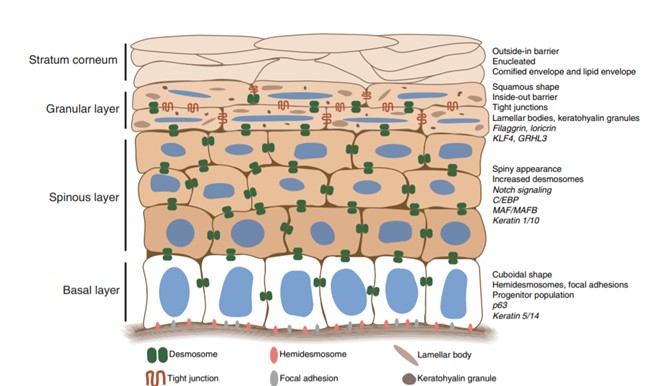
The largest organ of the human body is the skin. The skin is capable of many things which protect us from the outside environment, and it is composed of many layers. The epidermis is the top layer of skin and composed within it are 4 layers: Spinous layer, Granular layer, Stratum corneum, and the Basal layer (see figure below). All of these aspects help regulate the epidermal layer. Regulation of the epidermal layer Is essential in reducing inflammatory skin diseases and it’s the first line of defense against unwanted outsiders. The components of the epidermal layer help to ensure that inflammatory aspects and other skin conditions don’t arise such as Psoriasis. Major reasons that conditions arise is due to an irregulating of the skin.
When it comes to skin “within the epidermal differentiation complex on human chromosome one (mouse chromosome three), [there] contains multiple conserved gene encoding stratum-corneum proteins”; these genes are in a cluster termed LCE’s or Late Cornifying Envelopes (Jackson 2005). These envelopes are composed of 18 genes within chromosome 1 of the human genome and chromosome 3 of mice genomes. Although their function isn’t completely understood, it has been hypothesized that their main function is as an antimicrobial asset to the body. Given that their true purpose is not known yet, the antimicrobial hypothesis is constantly being tested and redeveloped. Having an understanding of the function that LCE’s provide will allow for better dermatological care in the future as well as to better help identify why certain conditions rise or fall.
 ) )
Late Cornifying Envelope Characteristics
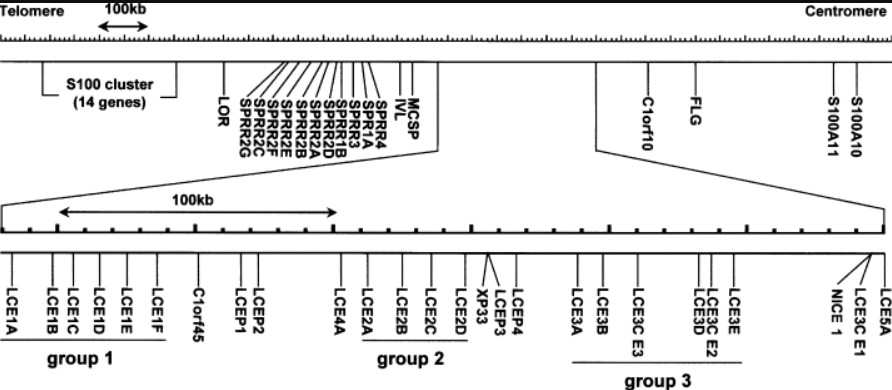
LCE’s are consistent of 3 groups: LCE1, LCE2, and LCE3. The full display of the gene cluster can be found in figure 2. Research has found that LCE3B and LCE3C genes, is under regulation of psoriasis-associated Th1 and Th17 cytokines which is a strong indication of the way that the LCE3 cluster functions and attributes to the epidermal layer (Hanna Niehues). When it comes to the capabilities of LCE3 it has been found that LCE3 proteins cause a rapid killing which is reminiscent of the kinetics of killing by human neutrophil defensins where the outer and inner membrane of Escherichia coli are sequentially permeabilized within 30–60 minutes (Lehrer et al., 1989). In addition to this capability, it has also been found that LCE3 is primarily respondent to inflammation of the epidermal layer. As far as the other gene clusters such as LCE1 and LCE2 there has yet to be found research on those clusters and their potential specified capabilities. Predictions are that they respond in a similar way to LCE3 but may have a specified role in aiding in that inflammatory response. This is another major question within the realm of LCE’s. Are these gene clusters and even individual genes coded to respond to specific stimuli different from its cluster neighbors?
As stated before, LCE’s are not restricted to the human genome. They are found in the mammalian community and their function is hypothesized to be about the same and just in different locations. “On human chromosome 1q21, a 2-Mb region called the epidermal differentiation complex comprises many genes encoding structural and regulatory proteins that are of crucial importance for keratinocyte differentiation and stratum corneum properties” (Henry, J 2012). Not only are LCE’s located here but a similar set of proteins are also present, and they are known as small proline-rich region proteins (SPRRs). These proteins are expected to hold very similar purposes as the ones housed in the LCE gene cluster. Not only that but its location is directly followed by the LCE location. Due to the proximity and similarity in these two epidermal components it only further pushes the idea that due to the position of LCE gene clusters, their functions can’t be too far off from each other.
[1]
LCE1a2
In this research specifically, LCE1a2 (found in mice) was looked into to try and create a structural model of it as well as produce a background. Although the specific function of the stratum-corneum proteins that this gene codes for was not determined, the information needed for potential sequencing and future studies was found. The general biological process of this protein is keratinization which was to be expected and further research confirmed it to be a signaling protein for the epidermis. Upon further research the structure of the gene was able to be estimated with 98 percent confidence with respect to the homology of the sequence to the structure formed utilizing Phyr2 programming. To achieve these result the DNA sequence of the LCE1a2 cluster was located via the uniprot page. Once the sequence was found a blast was conducted in order to identify the different proteins that the gene codes for. The protein labeled Late cornified envelope 1A2 Mus musculus (late_cornified_envelope_1A2_[Mus_musculus]) was chosen as it was of the same species and location of the intended search, it was also the highest match probability made by the system. Other proteins produces were late_cornified_envelope_protein_1C-like_[Onychomys_torridus], small_proline_rich-like_2,_partial_[Mus_musculus], small_proline_rich-like_3,_partial_[Mus_musculus], and late_cornified_envelope_1A1_[Mus_musculus]. The reason for the prevalence of small protein rich proteins is due to the reason stated prior which is the fact that LCE’s and SPPR’s are located right next to each other with the genome. As a result, their makeup will more than likely be very similar; due to the high predictive aspects involved with LCE’s currently, it is no surprise that SPRR’s showed up in the protein list as potential matches for the proteins that LCE gene 1a2 codes for. With all of that aside once the protein of intent was identified which was late_cornified_envelope_1A2_[Mus_musculus] it was run and analyzed. Results indicated can be found here. In addition to the protein, a look into the gene itself was done. The DNA sequence of the LCE1a2 gene was obtained and input into an in-silico Gibson assembly cloning method with Laser Gene. Results indicate that the gene has high complexity naturally making the sequencing process slightly more complex as well. The site used to determine complexity can be found here: after getting to the site be sure to click products and services then click costume DNA. This will allow you to view all of the information need to sequence your subject.
Although the direct capabilities of the proteins coded for via the LCE clusters are still not known, the information provided above gives not only background of the topic of LCE’s but also provides look into the structure and properties of a protein from LCE1a2 cluster. In addition to the characteristics of a protein found within the gene cluster, the steps used to find and analyze the protein was given. Alongside the protein a clonal sequence was produced to provide additional sequence characteristics such as melting point and complexity. Those results can be found here.
Structural highlights
Conclusion
Overall, the topic of late cornifying envelopes is still not fully known much like many other scientific topics; with that said this report provides key background information on the importance, location, proposed capabilities, as well as an idea of specific gene characteristics. With this information in mind further studies can be conducted to try and clone these genes and figure out their individual function and overall capabilities.
This is a sample scene created with SAT to color by Group, and another to make a transparent representation of the protein. You can make your own scenes on SAT starting from scratch or loading and editing one of these sample scenes.
- ↑ Hanson, R. M., Prilusky, J., Renjian, Z., Nakane, T. and Sussman, J. L. (2013), JSmol and the Next-Generation Web-Based Representation of 3D Molecular Structure as Applied to Proteopedia. Isr. J. Chem., 53:207-216. doi:https://dx.doi.org/10.1002/ijch.201300024
- ↑ Herraez A. Biomolecules in the computer: Jmol to the rescue. Biochem Mol Biol Educ. 2006 Jul;34(4):255-61. doi: 10.1002/bmb.2006.494034042644. PMID:21638687 doi:10.1002/bmb.2006.494034042644
|
References
Henry, J., Toulza, E., Hsu, C. Y., Pellerin, L., Balica, S., Mazereeuw-Hautier, J., Paul, C., Serre, G., Jonca, N., & Simon, M. (2012). Update on the epidermal differentiation complex. Frontiers in bioscience (Landmark edition), 17, 1517– 1532.https://doi.org/10.2741/401
Jackson, B., Tilli, C. M., Hardman, M. J., Avilion, A. A., MacLeod, M. C., Ashcroft, G. S., & Byrne, C. (2005). Late cornified envelope family in differentiating epithelia-response to calcium and ultraviolet irradiation. The Journal of investigative dermatology, 124(5), 1062–1070. https://doi.org/10.1111/j.0022202X.2005.23699.x
Lehrer RI, Barton A, Daher KA, Harwig SS, Ganz T, Selsted ME. Interaction of human defensins with Escherichia coli. Mechanism of bactericidal activity. J Clin Invest. 1989;84:553–61.
Moreci, R. S., & Lechler, T. (2020). Epidermal structure and differentiation. Current biology : CB, 30(4), R144–R149. https://doi.org/10.1016/j.cub.2020.01.004
Niehues, H., Tsoi, L. C., van der Krieken, D. A., Jansen, P., Oortveld, M., RodijkOlthuis, D., van Vlijmen, I., Hendriks, W., Helder, R. W., Bouwstra, J. A., van den Bogaard, E. H., Stuart, P. E., Nair, R. P., Elder, J. T., Zeeuwen, P., & Schalkwijk, J. (2017). Psoriasis-Associated Late Cornified Envelope (LCE) Proteins Have Antibacterial Activity. The Journal of investigative dermatology, 137(11), 2380– 2388. https://doi.org/10.1016/j.jid.2017.06.003


![[1]](https://ars.els-cdn.com/content/image/1-s2.0-S0022202X15322934-gr1.gif)