Sandbox Home: Difference between revisions

From Proteopedia
Jump to navigationJump to search
Joel L. Sussman (talk | contribs)
No edit summary
Joel L. Sussman (talk | contribs)
No edit summary
Line 4: Line 4:
   <tr>
   <tr>
     <td colspan="3" style="background:#F5F5FC; border:1px solid #ddd;">
     <td colspan="3" style="background:#F5F5FC; border:1px solid #ddd;">
       <div style="position:relative; top:0.2em; font-size:1.2em; padding:5px 5px 5px 10px; float:right;">
       <div style="position:relative; top:0.2em; font-size:1.2em; padding:5px 5px 5px 10px; text-align:right; display:block;">
        <b><i>ISSN 2310-6301</i></b>
  <b><i>ISSN 2310-6301</i></b>
      </div>
</div>


       <span style="display:block; margin:0; padding:0.3em; color:#000; font-style:italic; font-size:1.4em;">
       <span style="display:block; margin:0; padding:0.3em; color:#000; font-style:italic; font-size:1.4em;">

Revision as of 16:13, 30 September 2025

 ISSN 2310-6301
     
       As life is more than 2D, Proteopedia helps to bridge the gap between 3D structure & function of biomacromolecules
     
     
       Proteopedia presents this information in a user-friendly way as a collaborative & free 3D-encyclopedia of proteins & other biomolecules.
     
Selected Research Pages In Journals Education
BREAKTHROUGH in protein structure prediction!

by Eric Martz
After decades of slow progress by many groups, in 2020, AlphaFold2 proved able to accurately predict the detailed structures of two-thirds of single protein domains from their amino acid sequences. Pictured is AlphaFold2's prediction for the ORF8 protein of SARS-CoV-2 (black), compared with a subsequently published X-ray crystallographic structure (colors). ORF8 contributes to virulence in COVID-19.
>>> Visit this page >>>

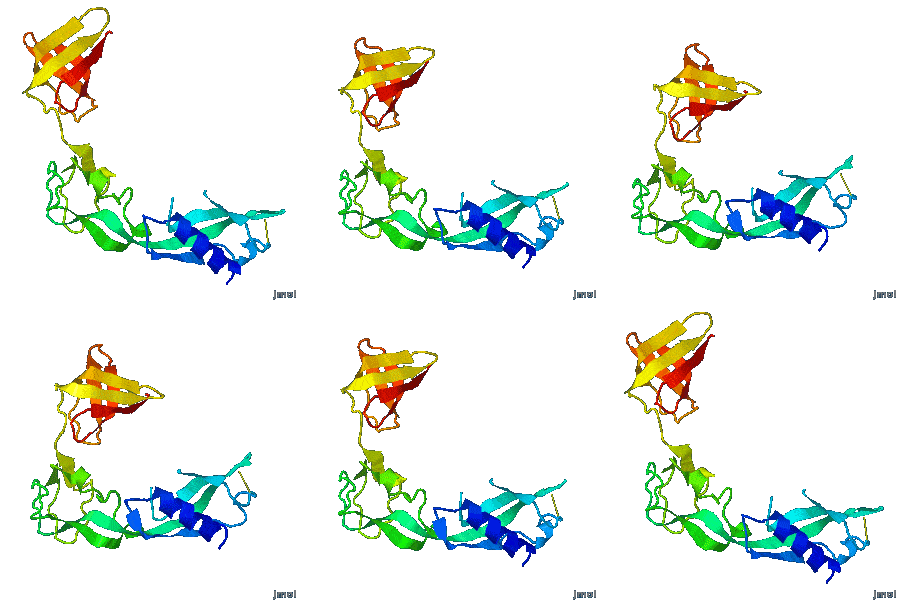
Structural flexibility of the periplasmic protein, FlgA, regulates flagellar P-ring assembly in Salmonella enterica.

H Matsunami, YH Yoon, VA Meshcheryakov, K Namba, FA Samatey. Scientific Reports 2016 doi: 10.1038/srep27399
A periplasmic flagellar chaperone protein, FlgA, is required for P-ring assembly in bacterial flagella of taxa such as Salmonella enterica or Escherichia coli. Here we present the open and closed crystal structures of FlgA from Salmonella enterica serovar Typhimurium, grown under different crystallization conditions. An intramolecular disulfide cross-linked form of FlgA caused a dominant negative effect on motility of the wild-type strain.

>>> Visit this I3DC complement >>>

Tutorial: The Ramachandran principle, phi (φ) and psi (ψ) angles in proteins

by Eric Martz
The Ramachandran Principle says that alpha helices, beta strands, and turns are the most likely conformations for a polypeptide chain to adopt, because most other conformations are impossible due to steric collisions between atoms. Check Show Clashes to see where non-bonded atoms are overlapping, and thus in physically impossible positions.

>>> Visit this tutorial >>>

About Contact Hot News Table of Contents Structure Index Help