Main Page: Difference between revisions

From Proteopedia
Jump to navigationJump to search
Jaime Prilusky (talk | contribs)
No edit summary
Jaime Prilusky (talk | contribs)
No edit summary
 
Line 11: Line 11:
<th class="mainPageSectionC">Education</th>
</tr>
</tr>
<td colspan="3">
 
<div class="proteopedia-featured-row">
<tr id="rowFeatured">
   <div class="proteopedia-featured" data-featured-set="SEL"></div>
   <td>{{#overlaysfeatured:SEL}}</td>
   <div class="proteopedia-featured" data-featured-set="JRN"></div>
   <td>{{#overlaysfeatured:JRN}}</td>
   <div class="proteopedia-featured" data-featured-set="EDU"></div>
   <td>{{#overlaysfeatured:EDU}}</td>
</div>
</td>
</tr>
</tr>
<tr id="rowClosingColors"><td class="mainPageSectionA">&nbsp;</td>
<td class="mainPageSectionB">&nbsp;</td>

Latest revision as of 04:50, 2 October 2026

ISSN 2310-6301
As life is more than 2D, Proteopedia helps to bridge the gap between 3D structure and function of biomacromolecules.
Proteopedia presents this information in a user-friendly way as a collaborative & free 3D-encyclopedia of proteins & other biomolecules.
Selected Research Pages In Journals Education
Metal-Ligand Nano-Cages

This self-assembling structure has an interior cavity about 32 Å in diameter. It consists of 24 palladium ions, each of which is coordinated by 4 nitrogens, which are part of 48 dipyridylthiophene molecules. Such synthetic nano-spheres can be functionalized to create synthetic receptors and nanoreactors. Potential applications in sensing, catalysis, and drug delivery are being explored.

>>> See more animations and explanation >>>

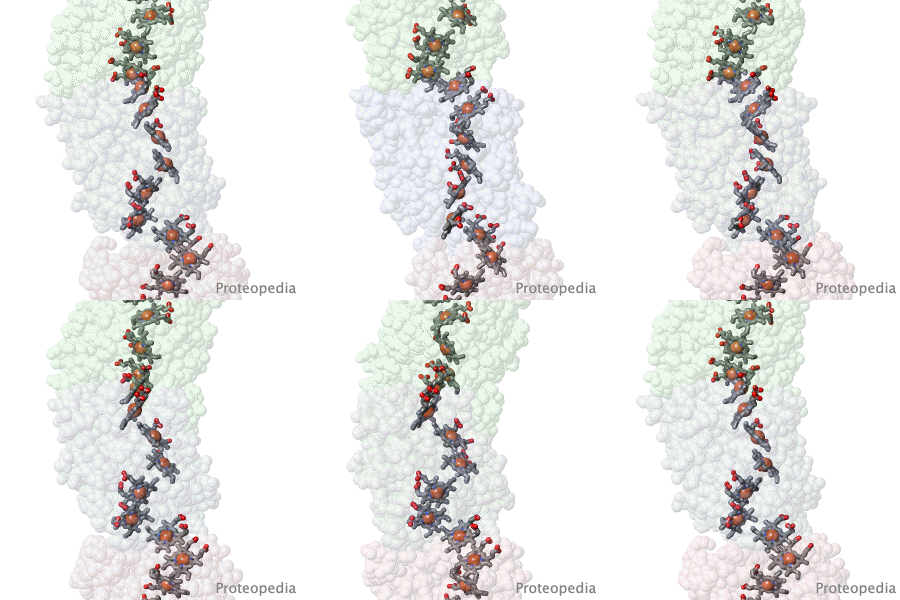
Geobacter nanowire structure surprise.

F Wang, Y Gu, JP O'Brien, SM Yi, SE Yalcin, V Srikanth, C Shen, D Vu, NL Ing, AI Hochbaum, EH Egelman, NS Malvankar. Cell 2019 doi: 10.1016/j.cell.2019.03.029
Bacteria living in anaerobic environments (no oxygen) need alternative electron acceptors in order to get energy from their food. An acceptor abundant in the earth's crust is red iron oxide ("rust"), which gets reduced to black iron oxide (magnetite). Many bacteria, such as Geobacter, get their metabolic energy by transferring electrons to acceptors that are multiple cell diameters distant, using protein nanowires. These were long thought to be pili. But when the structure of the nanowires was solved in 2019, to everyone's surprise, they turned out to be unprecedented linear polymers of multi-heme cytochromes. The hemes form an electrically conductive chain in the cores of these nanowires.

>>> Visit I3DC Interactive Visualizations >>>

Tutorial: How do we get the oxygen we breathe

J Prilusky, E Hodis doi: 10.14576/431679.1869588
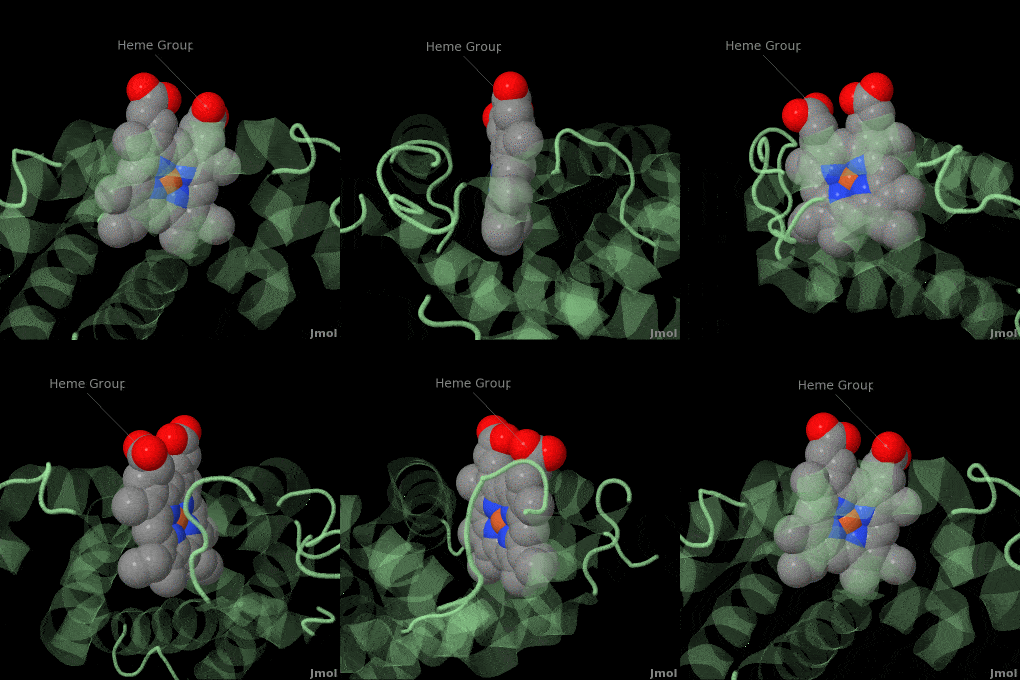
This tutorial is designed for high school and beginning college students. When we breathe oxygen from the air is taken up by blood in our lungs and soon delivered to each of the cells in our body through our circulatory system. Among other uses, our cells use oxygen as the final electron acceptor in a process called aerobic respiration – a process that converts the energy in food and nutrients into a form of energy that the cell can readily use (molecules of ATP, adenosine triphosphate).

>>> Visit this tutorial >>>


How to add content to Proteopedia
Video Guides
Who knows ...

About Interactive 3D Complements - I3DCs
List of I3DCs
How to get an I3DC for your paper

Teaching strategies using Proteopedia
Examples of pages for teaching
How to add content to Proteopedia

Proteopedia Page Contributors and Editors (what is this?)

Jaime Prilusky, Joel L. Sussman, Angel Herraez