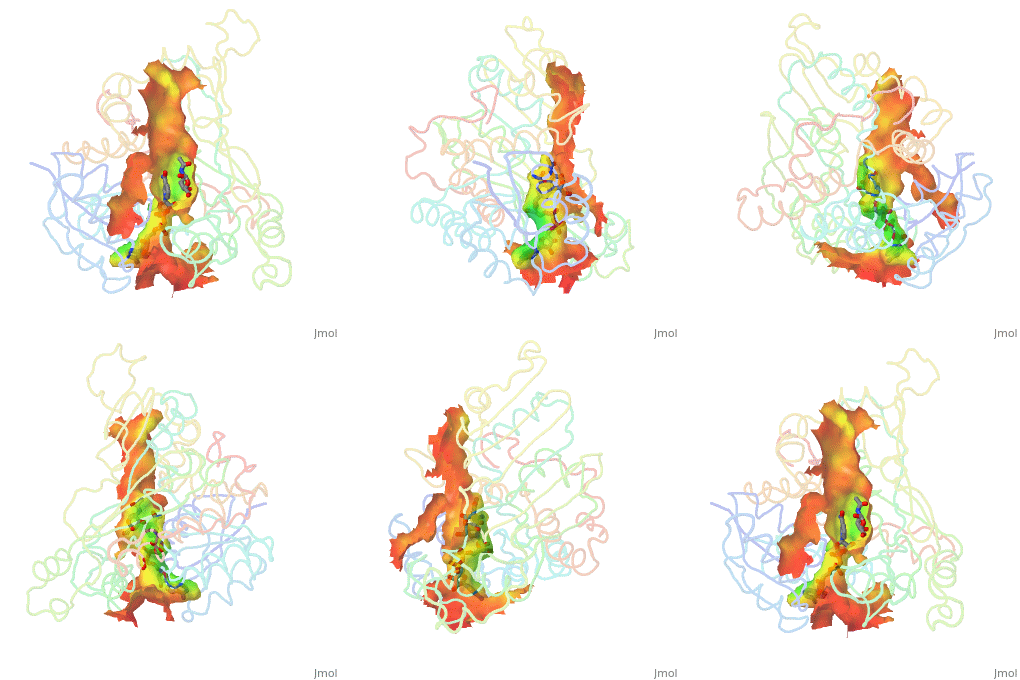
When we breathe, or respire, oxygen from the air is taken up by blood in our lungs and soon delivered to each of the cells in our body through our circulatory system. Among other uses, our cells use oxygen as the final electron acceptor in a process called aerobic respiration -- a process that converts the energy in food and nutrients into a form of energy that the cell can readily use (molecules of ATP, adenosine triphosphate). The cells of large organisms like humans use aerobic respiration because other forms of energy production are less efficient, and oxygen is plentiful. (THINK: Do fish use aerobic respiration?)
But, although oxygen is transported in our blood to reach each of the cells in our body, oxygen does not dissolve well in blood. So how is oxygen transported in the blood?. (more...)
November 2024: How To Find A Structure is a new guide to finding an empirical model for a protein of interest, choosing which empirical structure is best, and getting an AlphaFold-predicted structure when no empirical structures are available.
March 2024: Professors are using Proteopedia for class projects in Brazil, Czech Republic, France, and various states in the USA. See the updated Adoptions in College and University Classes.
What happens if a SARS-CoV-2 coronavirus enters your lung? See a clear explanation at Lifecycle of SARS-CoV-2
5,000 users!! On December 4, 2021, the number of Proteopedia users went over 5,000. The 5,000th user is from Juniata College, Huntingdon, Pennsylvania, US
AlphaFold protein structure predictions - a step change for biology, an electronic talk by EBI staff for students and early career researchers via FEBS Junior Sections, Oct. 26, 2021, 19:00 CEST. Announcement. Registration.
A practical guide to teaching with Proteopedia [1]
June, 2016: Proteopedia uses the Biological Assemblies from PDBe as the default scenes for all PDB entry pages. Thus, based on the curation by EBI (host for PDBe) the most biologically significant structure is shown.
June, 2015: Award Ceremony for the the Proteopedia Award at the ICSG2015 - Deep Sequencing Meets Structural Biology, awarded on 10-Jun-2015 at the Weizmann Institute of Science
December, 2014, Talking about Proteopedia on 12/04/14-12/06/14, a live online talk organised by DivCHED CCCE: Committee on Computers in Chemical Education
October, 2014 Course in Spanish/English on Proteopedia and its uses to study, display and teach macromolecules.
↑Castro C, Johnson RJ, Kieffer B, Means JA, Taylor A, Telford J, Thompson LK, Sussman JL, Prilusky J, Theis K. A practical guide to teaching with Proteopedia. Biochem Mol Biol Educ. 2021 Jun 3. doi: 10.1002/bmb.21548. PMID:34080750 doi:https://dx.doi.org/10.1002/bmb.21548