by [list all teammate names here]
Student Projects for UMass Chemistry 423 Spring 2016
Overall Structure
The ligand binding domain of the aspartate receptor (Initial view) ) is a dimer of two 4-helix bundles that is shown here with the aspartate ligand bound.[1] In this rainbow representation the N and C termini are at the bottom of the structure; this is where the connections to the transmembrane helices have been truncated.
Binding Interactions
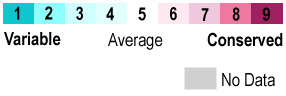
When the protein is colored according to sequence conservation , residues at the ligand site are the most conserved.
Interactions that stabilize ligand binding[2] include hydrogen bonding from Tyr149 and Gln152 backbone carbonyls and Thr154 sidechain OH to the ligand amino group and hydrogen bonding from the sidechain nitrogens of Arg64, Arg69, and Arg73 to the two ligand carboxyl groups.
Additional Features
Quiz Question 1
See Also
Credits
Introduction - name of team member
Overall Structure - name of team member
Binding Interactions - name of team member
Additional Features - name of team member
Quiz Question 1 - name of team member
References
- ↑ Yeh JI, Biemann HP, Pandit J, Koshland DE, Kim SH. The three-dimensional structure of the ligand-binding domain of a wild-type bacterial chemotaxis receptor. Structural comparison to the cross-linked mutant forms and conformational changes upon ligand binding. J Biol Chem. 1993 May 5;268(13):9787-92. PMID:8486661
- ↑ Milburn MV, Prive GG, Milligan DL, Scott WG, Yeh J, Jancarik J, Koshland DE Jr, Kim SH. Three-dimensional structures of the ligand-binding domain of the bacterial aspartate receptor with and without a ligand. Science. 1991 Nov 29;254(5036):1342-7. PMID:1660187

