Main Page

From Proteopedia
Revision as of 07:14, 21 October 2018 by Joel L. Sussman (talk | contribs)
Jump to navigationJump to search
ISSN 2310-6301

Because life has more than 2D, Proteopedia helps to understand relationships between structure and function. Proteopedia is a free, collaborative 3D-encyclopedia of proteins & other molecules.


Selected Pages Art on Science Journals Education
Bacteria float with nano-balloons.

ST Huber, D Terwiel, WH Evers, D Maresca, AJ Jakobi. Preprint 2022 doi: 10.1101/2022.05.08.489936
Many kinds of bacteria and archaea control their buoyancy to move to optimal positions in liquid environments. They do this by making nano-compartments called "gas vesicles", long "pipes" with closed ends filled with gases. In 2022, gas vesicle structure was solved, revealing self-assembling thin-walled cylinders of remarkable strength with gas-permeable pores and water-repelling (hydrophobic) interiors. Building on this structural knowledge, gas vesicles are being engineered to serve as biosensors that report via ultrasound.

>>> Visit I3DC Interactive Visualizations >>>

Opening a Gate to Human Health

by Alice Clark (PDBe)
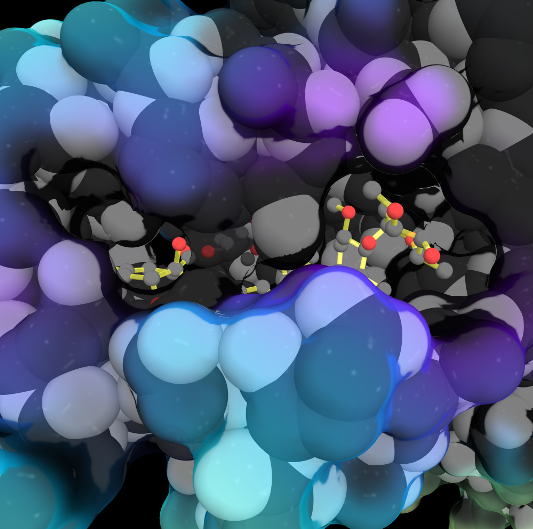
In the 1970s, an exciting discovery of a family of medicines was made by the Japanese scientist Satoshi Ōmura. One of these molecules, ivermectin, is shown in this artwork bound in the ligand binding pocket of the Farnesoid X receptor, a protein which helps regulate cholesterol in humans. This structure showed that ivermectin induced transcriptional activity of FXR and could be used to regulate metabolism.

>>> Visit this page >>>

Interconversion of the specificities of human lysosomal enzymes associated with Fabry and Schindler diseases.

IB Tomasic, MC Metcalf, AI Guce, NE Clark, SC Garman. J. Biol. Chem. 2010 doi: 10.1074/jbc.M110.118588
The human lysosomal enzymes α-galactosidase and α-N-acetylgalactosaminidase share 46% amino acid sequence identity and have similar folds. Using a rational protein engineering approach, we interconverted the enzymatic specificity of α-GAL and α-NAGAL. The engineered α-GAL retains the antigenicity but has acquired the enzymatic specificity of α-NAGAL. Conversely, the engineered α-NAGAL retains the antigenicity but has acquired the enzymatic specificity of the α-GAL enzyme. Comparison of the crystal structures of the designed enzyme to the wild-type enzymes shows that active sites superimpose well, indicating success of the rational design. The designed enzymes might be useful as non-immunogenic alternatives in enzyme replacement therapy for treatment of lysosomal storage disorders such as Fabry disease.

>>> Visit this I3DC complement >>>

Virus Capsid Geometry

The Capsid of a virus is its outer shell or "skin". Viruses have evolved intricate and elegant ways to assemble capsid protein chains into complete, usually spherical capsids, often with icosahedral symmetry. Pictured is an extremely simplified model of a capsid, where a single enlarged atom represents each of the 360 protein chains in the capsid of the Simian Virus 40 (SV40), a member of a group of cancer-causing viruses that has been extensively researched for decades.

>>> See more animations and explanation >>>

How to add content to Proteopedia

Video Guides

Who knows ...

All Art on Science

List of Interactive 3D Complements (I3DC)

How to get an I3DC for your paper

About I3DC

Teaching Strategies Using Proteopedia

Examples of Pages for Teaching

How to author pages and contribute to Proteopedia

About Table of Contents Structure Index Help

Proteopedia Page Contributors and Editors (what is this?)

Jaime Prilusky, Joel L. Sussman, Angel Herraez