Main Page

From Proteopedia
Revision as of 07:46, 21 October 2018 by Joel L. Sussman (talk | contribs)
Jump to navigationJump to search
ISSN 2310-6301

Because life has more than 2D, Because life is more than 2D, Proteopedia aids in understanding the 3D relationships between function & structure of biomacromolecules


Selected Pages Art on Science Journals Education
Coronavirus COVID-19

A novel coronavirus was found to be the cause of a respiratory illness first detected in Wuhan, China in 2019. 3D structural studies are aiding scientists to understand how the coronavirus infects humans and helping to find new ways to treat the viral spread (video by Fusion Animation).

>>> Visit this page >>>

Opening a Gate to Human Health

by Alice Clark (PDBe)
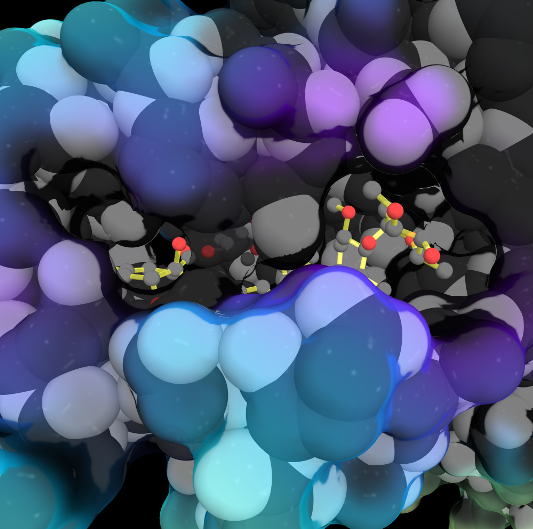
In the 1970s, an exciting discovery of a family of medicines was made by the Japanese scientist Satoshi Ōmura. One of these molecules, ivermectin, is shown in this artwork bound in the ligand binding pocket of the Farnesoid X receptor, a protein which helps regulate cholesterol in humans. This structure showed that ivermectin induced transcriptional activity of FXR and could be used to regulate metabolism.

>>> Visit this page >>>

Structure of Anticancer Ruthenium Half-Sandwich Complex Bound to Glycogen Synthase Kinase 3ß

G Atilla-Gocumen, L Di Costanzo, E Meggers. J Biol Inorg Chem. 2010 doi: 10.1007/s00775-010-0699-x
A crystal structure of an organometallic half-sandwich ruthenium complex bound to glycogen synthase kinase 3ß (GSK-3ß) reveals that the inhibitor binds to the ATP binding site via an induced fit mechanism utilizing several hydrogen bonds and hydrophobic interactions. Importantly, the metal is not involved in any direct interaction with the protein kinase but fulfills a purely structural role.

>>> Visit this I3DC complement >>>

You Are What You Eat!

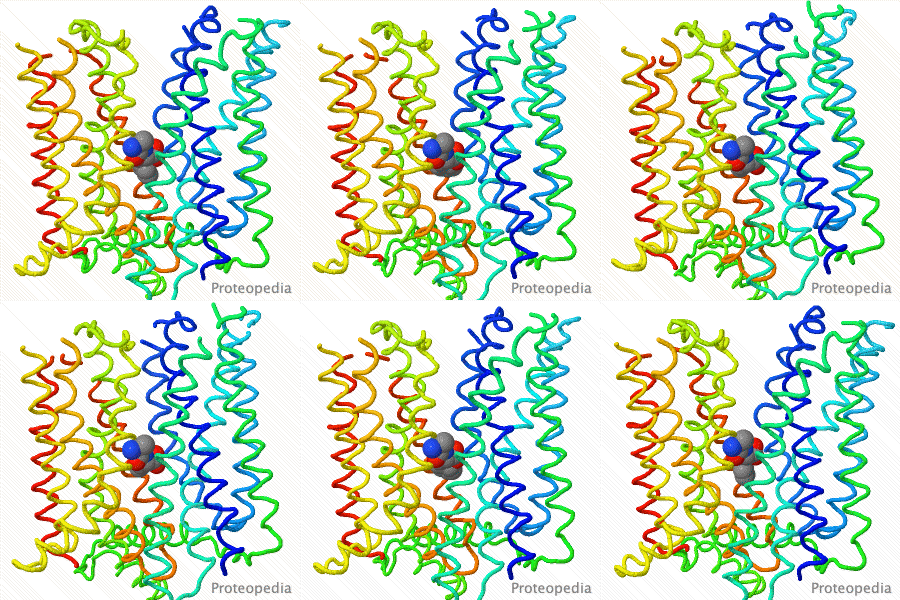
Above is an integral membrane protein that takes up, into your intestinal cells, orally consumed peptide nutrients and drugs. Its lumen-face (top) opens and binds peptide or drug (small solid object in the center), then closes, while its cytoplasmic face (bottom) opens to release its cargo into the intestinal cell, which passes it on to the blood circulation.

>>> See more animations and explanation >>>

How to add content to Proteopedia

Video Guides

Who knows ...

List of Art on Science pages in Proteopedia

What is an Interactive 3D Complement (I3DC)?

List of I3DCs

How to get an I3DC for your paper

Teaching Strategies Using Proteopedia

Examples of Pages for Teaching

How to add content to Proteopedia

About Table of Contents Structure Index Help

Proteopedia Page Contributors and Editors (what is this?)

Jaime Prilusky, Joel L. Sussman, Angel Herraez