Main Page

From Proteopedia
Revision as of 15:40, 16 February 2026 by Angel Herraez (talk | contribs) (fixing CSS for Main Page)
Jump to navigationJump to search
ISSN 2310-6301

As life is more than 2D, Proteopedia helps to bridge the gap between 3D structure and function of biomacromolecules.

Proteopedia presents this information in a user-friendly way as a collaborative & free 3D-encyclopedia of proteins & other biomolecules.

Selected Research Pages In Journals Education
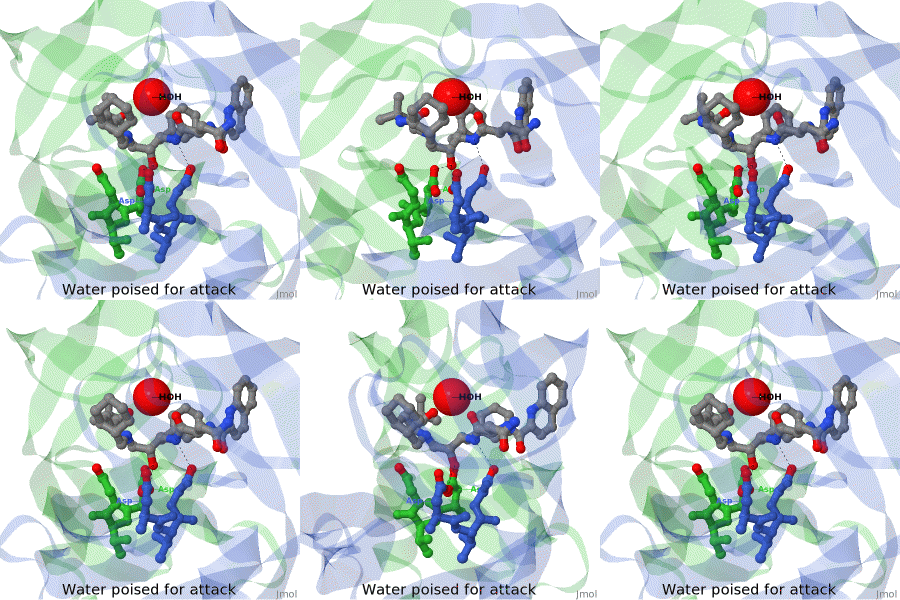
HIV-1 protease

by David Canner
The X-ray structure of HIV-1 protease reveals that it is composed of two symmetrically related subunits which form a tunnel where they meet. This is critical because it contains the active site of the protease, consisting on two Asp-Thr-Gly conserved sequences, making it a member of the aspartyl protease family. The two catalytic Asp's either interact with the incoming water or protonate the carbonyl to make the carbon more electrophilic for the incoming water.

>>> Visit this page >>>

Geobacter pili: surprising function.

Y Gu, V Srikanth, AI Salazar-Morales, R Jain, JP O'Brien, SM Yi, RK Soni, FA Samatey, SE Yalcin, NS Malvankar. Nature 2021 doi: 10.1038/s41586-021-03857-w
Geobacter pili were long thought to be electrically conductive protein nanowires composed of PilA-N. Nanowires are crucial to the energy metabolism of bacteria flourishing in oxygen-deprived environments. To everyone's surprise, in 2019, the long-studied nanowires were found to be linear polymers of multi-heme cytochromes, not pili. The first cryo-EM structure of pili (2021) reveals a filament made of dimers of PilA-N and PilA-C, shown. Electrical conductivity of pili is much lower than that of cytochrome nanowires. Evidence suggests that PilA-NC filaments are periplasmic pseudopili crucial for exporting cytochrome nanowires onto the cell surface, rather than the pili serving as nanowires themselves.

>>> Visit I3DC Interactive Visualizations >>>

Touch-Sensitive Channel

Touching stretches cell membranes, opening mechanosensitive ion channels, leading to sensation by the nervous system. Pictured is the transmembrane region of a similar channel in bacteria. When closed, the narrow opening is lined by hydrophobic amino acid sidechains, making it non-conductive to ions.

>>> See more animations and explanation >>>

How to add content to Proteopedia
Video Guides
Who knows ...

About Interactive 3D Complements - I3DCs
List of I3DCs
How to get an I3DC for your paper

Teaching strategies using Proteopedia
Examples of pages for teaching
How to add content to Proteopedia

Proteopedia Page Contributors and Editors (what is this?)

Jaime Prilusky, Joel L. Sussman, Angel Herraez