Beta Secretase 1SGZ
Beta-secretase, also known as BACE or Memapsin 2, is encoded by the gene BACE1. Beta-secretase is a proteolytic, transmembrane enzyme with two active sites on the extracellular region. It is associated with processing hydrolases (APP), which is an integral membrane protein.[1] A malfunction in the processing of APP results in the formation of the peptide amyloid beta. Amyloid-beta is a neurotoxic peptide segment that aggregates into plaques. These plaques are the primary component of plaques found in individuals with Alzheimers Disease. [2] Other biological associations of this enzyme include modulating myelination in the central and peripheral nervous systems.[3]
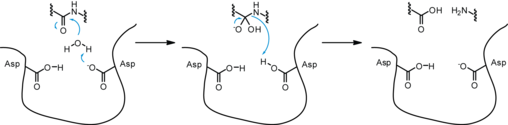
ContentsEnzyme ClassBeta-secretase is an enzyme that is classified as a class 3 enzyme, which are hydrolases [1]. The enzyme acts on breaking peptide bonds and therefore is also considered a peptidase and belongs to the subclass of aspartic acid endopeptidases.[2] StructureBACE1 is a type-1 integral membrane glycoprotein that is affected by the positions on the outer domains of amino acids [3] . BACE1 prefers the cleavage of longer substrates over smaller peptide based substrates because of the acidic pH of 4.5. This acidic pH is the result of the cleavage of peptide based substrates. The acidic, polar environment of the enzyme allows a wide variety of substrates to bind to the membrane. Cleavage of soluble substrates is possible in the external environment due to the enzyme’s high Km value which fail to observe in the internal environment [4]. The two catalytic aspartate residues that reside in the active site of BACE1 are Asp 32 and 228 [3]. The active site of BACE1 has a flexible, antiparallel-hairpin. This is also known as a flap, which is found in the residues of 67-77. These residues control the accessibility of the substrate to the active site. The flap also has to position the substrate in the correct orientation for catalysis. In an open conformation the active site allows the substrate to enter without any difficulty and regulates its activity. In an inactive form the binding affinity to the inhibitor is decreased, which then lowers the substrate binding and enzymatic activity. For the closed conformation the flap with the inhibitor bound is firmly secured in place [4]. Another notable structure found in beta-secretase is the S3 pocket. The S3 pocket is adjacent to the Thr 232 and the amino acids from the 10s loop, which contains Glycine and Glutamine. The Glycine located in the 10s loop forms a hydrogen bond with the substrate that helps to stabilize the 10s loop. This further balances the interaction of the beta-secretase substrate. In an open conformation of the 10s loop, the substrate and the S3 pocket have a greater affinity to bind with each other. The stabilization of the structure depends on the active site, flap and 10s loop [5]. Specifically, BACE1 is a transmembrane aspartic protease, which cleaves the amyloid-beta precursor protein and produces the amyloid-beta peptide. Two water molecules are utilized in the process of the aspartic protease. The location of the first water molecule for BACE1 is between the Asp 32 and 228. Once the substrate binds, the two aspartate residues form a hydrogen bond with the water molecule. The water molecule becomes the nucleophile and attacks the carbonyl. The second water molecule forms a hydrogen bond with the Tyr residue that is found in the flap. The behavior of the two water molecules affects the activity of BACE1 [4]. Active Site MechanismThe mechanism of this protease activity is an acid-base reaction, common in organic chemistry. The two aspartate molecules coordinate a water molecule through hydrogen bonding. The aspartate molecule takes a hydrogen from a water molecule, which activates the water as a good nucleophile. The good water nucleophile attacks the carbonyl carbon in the peptide bond and with the attack forms a tetrahedral intermediate [6]. A pair of electrons are moved to re-create a carbonyl group, which breaks the peptide bond and re-generates an aspartic oxyanion [7]. No covalent bonds are formed between the beta-secretase side chains and the substrate on the enzyme and therefore the fragments can exit the active site easily.
The active site mechanism of beta secretase. [8] FunctionBACE1 plays a main role for the proteolytic processing of APP. The main function is to release the extracellular material of the beta-cleaved soluble APP by the cleaving of the N-terminus of the alpha-beta peptide sequence, while the C-terminal fragment is released by a process of gamma-secretase [3]. However, beta-secretase malfunctions to cleave APP in a different position creating amyloid-beta. These fragments of amyloid-beta then aggregate and form harmful plaques that can spread throughout the body causing Alzheimer’s Disease. Beta-secretase also takes place in the formation of myelin sheaths in the peripheral nerve cells [6].
In a general reaction, APP is initially cleaved by alpha-secretase in a certain position every time and then by gamma-secretase. Neurons may benefits from the released fragments produced by the alpha-secretase and gamma-secretase cleavage of APP [6]. However, when beta-secretase enters the equation the cleavage of APP changes positions. Once gamma-secretase has officially completed its cleavage, amyloid-beta is released into the extracellular membrane space. Amyloid-beta is most commonly found to aggregate in this area and form plaques that are extremely harmful to the human body. It is thought that this plaque build up is the initial cause of Alzheimer’s disease in the brain [7]. Alzheimer's DiseaseAlzheimer’s disease is an unfortunate neurodegenerative disease that degrades the nervous system, specifically the destruction of neurons in the brain. The brain mass of a person with this disease is significantly reduced over time as brain neurons and brain function diminishes. The amyloid plaque, a product of APP, is what aggregates in the brain and degrades neuron function. The loss of neuron function and inability to make synapses in the brain eventually leads to dementia in Alzheimer’s disease patients, which reduces the patient’s memory. The reduction of memory results in the brain's capacity being reduced, which impacts the functioning of the patient’s normal daily life routines and eventually results in death. In the later stages of Alzheimer’s disease, when brain capacity and function is very low, typically the patient needs to be cared for because they are not able to live their normal life and care for themselves on a daily basis as a normal person would[10]. Alzheimer’s disease occurs because of plaques that are formed from the buildup of amyloid-beta. Amyloid-beta is a four kilodalton protein made up of about 39-43 amino acids in length, which aggregates in the brain and causes the destruction of neurons [11]. Amyloid-beta is cleaved from the membrane protein APP by two proteases, beta-secretase and gamma-secretase. Amyloid-betas are amphiphilic peptides with residues 1-28 having hydrophilic properties at the N-terminal side. In contrast, residues 29-40 are located at the C-terminal side and have hydrophobic characteristics. These attributes of amyloid-beta are what affect the toxicity of the peptide aggregates in the brain[12]. InhibitorsIn recent years there has been much work done with beta-secretase inhibitors and synthesizing therapeutic drugs that will inhibit the production of beta-amyloids. An area that has specifically been studied is beta-secretase processing of APP. Processing of APP is the first step in the synthesis of amyloid-beta, and therefore inhibiting it could be a successful way to prevent the development of Alzheimer's diseases[13]. Two main types of beta-secretase inhibitors that are being studied include; peptidomimetic beta-secretase inhibitors and nonpeptidomimetic beta-secretase inhibitors[14]. Peptidomimetic beta-secretase inhibitors focus on substrate-based inhibition and were created by analyzing the specificity and kinetics of the beta-secretase enzyme. One specific development of a peptidomimetic beta-secretase inhibitor, by the Elan/Pharmacia team, involves a cell-permeable, dose-dependent, mechanism-specific reduction of the harmful amyloid-beta substance in human embryonic cells. Identification of a specific sequence, P16 to P5’, in beta-secretase substrate was the key discovery that led to the development of a peptidomimetic beta-secretase inhibitor. This beta-secretase inhibitior functions by replacing the P1 residue with a statine, which is uncleavable, and replacing the P1’ aspartate with a valine. The new analogue created was then used to synthesize purified beta-secretase that was sequenced and cloned. The N-terminus and the C-terminus of the synthesized and purified beta-secretase were truncated to create a small peptide inhibitor, which was then transformed into a cell-permeable peptidomimetic beta-secretase inhibitor by dividing it into three regions. The regions included: an N-terminus, a C-terminus, and central core section that included statine. The Elan/Pharmacia targeted these three regions and focused on modifying them to result in less peptidic qualities but still keep beta-secretase enzyme activity[15]. Nonpeptidomimetic beta-secretase inhibitors have been more challenging to create and currently most companies have only published patent applications[14]. Some work is currently being done by Neurologic using heterocyclic compounds, which act by indirectly increasing alpha-sAPP and shifting APP processing. This shift modifies APP processing, which acts to inhibit the production of beta-amyloids. The inhibition of beta-amyloids prevents the formation of beta-amyloid aggregates and harmful plaques in hopes to prevent the development of Alzheimer's Disease [15].
| ||||||||||||


References
- ↑ Ghosh, A.; Kumaragurubaran, N.; Hong, L.; Koelsh, G.; Tang, J. Memapsin 2 (Beta-Secretase) Inhibitors: Drug Development. CAR Current Alzheimer Research. [Online] 2008, 5, 121–131. https://jamesmadisonva.library.ingentaconnect.com/content/ben/car/2008/00000005/00000002/art00004
- ↑ John, V.; Beck, J. P.; Bienkowski, M. J.; Sinha, S.; Heinrikson, R. L. Human β-Secretase (BACE) And BACE Inhibitors. ChemInform. [Online] 2004, 35, 4625-4630. https://pubs.acs.org/doi/pdf/10.1021/jm030247h
- ↑ Hu, X.; Hicks, C. W.; He, W.; Wong, P.; Macklin, W. B.; Trapp, B. D.; Yan, R. Bace1 Modulates Myelination in the Central and Peripheral Nervous System. Nature Neuroscience Nat Neurosci. [Online] 2006, 9, 1520–1525. https://www.nature.com/neuro/journal/v9/n12/abs/nn1797.html