We apologize for Proteopedia being slow to respond. For the past two years, a new implementation of Proteopedia has been being built. Soon, it will replace this 18-year old system. All existing content will be moved to the new system at a date that will be announced here.
CHEM2052 Tutorial Example4
From Proteopedia
(Difference between revisions)
| Line 11: | Line 11: | ||
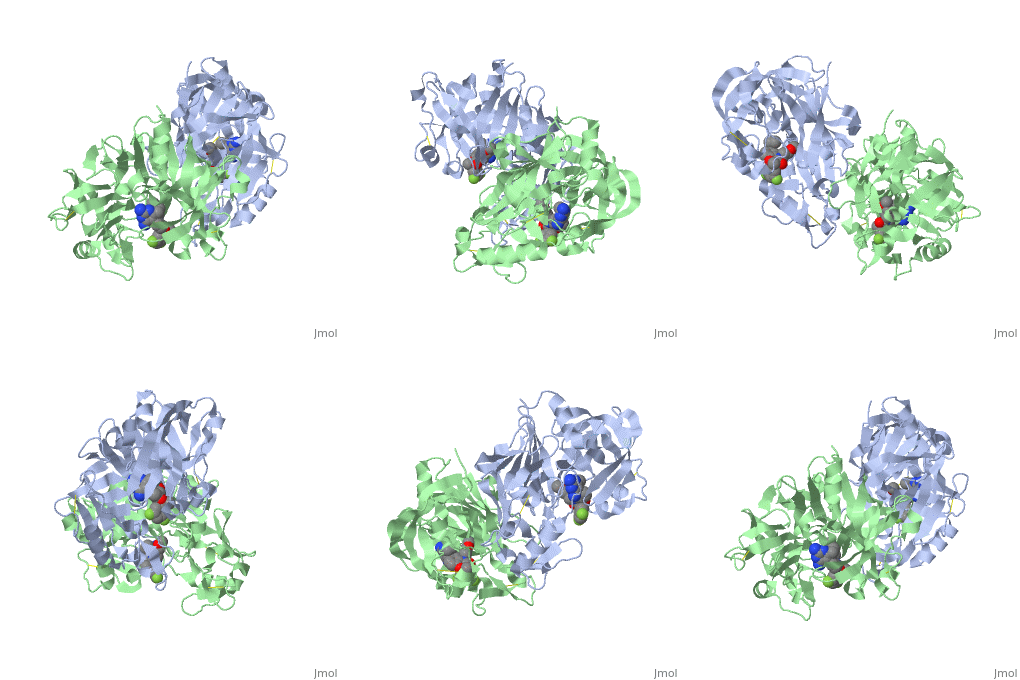
Since the 1970s scientists have been trying to modulate the action of renin by blocking the active site of the enzyme and preventing its function, hence lowering blood pressure. Aliskerin is the only renin inhibitor in clinical use today [http://en.wikipedia.org/wiki/Renin_inhibitor Renin information Site]. However there is still interest in developing new, improved inhibitors. This question looks at a renin inhibitor identified through research at Pfizer.<ref>PMID:17574423</ref> | Since the 1970s scientists have been trying to modulate the action of renin by blocking the active site of the enzyme and preventing its function, hence lowering blood pressure. Aliskerin is the only renin inhibitor in clinical use today [http://en.wikipedia.org/wiki/Renin_inhibitor Renin information Site]. However there is still interest in developing new, improved inhibitors. This question looks at a renin inhibitor identified through research at Pfizer.<ref>PMID:17574423</ref> | ||
| - | == '''Active | + | == '''Active Site''' == |
This representation illustrates the <scene name='59/596437/Renin_catalytic_residues/2'>active site catalytic residues</scene> of Renin. | This representation illustrates the <scene name='59/596437/Renin_catalytic_residues/2'>active site catalytic residues</scene> of Renin. | ||
== '''Inhibition of Renin''' == | == '''Inhibition of Renin''' == | ||
| - | This scene shows the <scene name='55/559112/active site of renin with the Pfizer inhibitor bound | + | This scene shows the <scene name='55/559112/Renin_catalytic_residues/1'>active site of renin with the Pfizer inhibitor bound</scene>. Which part of the inhibibtor binds to the catalytic residues of the active site? |
| - | <scene name='55/559112/Renin_catalytic_residues/1'>Renin Catalytic Residues</scene> | ||
| - | '''Serine proteases''' account for over one-third of all known proteolytic enzymes <ref>PMID:17991683</ref>,<ref name="DiCera">PMID:19180666</ref>. Within the diverse collection of serine proteases, the most famous members are trypsin, chymotrypsin and elastase. Aside from their key roles in digestion (and other physiological processes) <ref name ="DiCera"/>, the unique specificities of these enzymes make them useful tools in biochemistry and molecular biology to ascertain protein sequences. | ||
| - | |||
| - | Looking at the structures below, it is apparent that these three enzymes have similar folds. This conservation of tertiary structure is due to extensive similarities at the level of primary amino acid sequence. However, there are small differences in amino acid sequence among the proteins, which are reflected in their different specificities. Each protein cleaves the peptide backbone after (or on the carbonyl side) of a specific type of sidechain. After examining the molecular basis for these functional similarities and differences, you will hopefully see why serine proteases are a classic example of how '''''structure dictates function'''''! | ||
| - | |||
| - | *<scene name='User:Amy_Kerzmann/Sandbox_5/New_chymotrypsin-triad/2'>Chymotrypsin</scene> | ||
| - | *<scene name='User:Amy_Kerzmann/Sandbox_5/New_trypsin-wt-triad/4'>Trypsin</scene> | ||
| - | *<scene name='User:Amy_Kerzmann/Sandbox_5/New_elastase-triad/3'>Elastase</scene> | ||
| - | |||
| - | |||
| - | |||
| - | |||
| - | |||
| - | |||
| - | |||
| - | == Active Site and Mechanism == | ||
== Inhibitors == | == Inhibitors == | ||
Revision as of 05:38, 13 August 2014
CHEM2052_Tutorial_Example4
| |||||||||||
References
- ↑ Powell NA, Ciske FL, Cai C, Holsworth DD, Mennen K, Van Huis CA, Jalaie M, Day J, Mastronardi M, McConnell P, Mochalkin I, Zhang E, Ryan MJ, Bryant J, Collard W, Ferreira S, Gu C, Collins R, Edmunds JJ. Rational design of 6-(2,4-diaminopyrimidinyl)-1,4-benzoxazin-3-ones as small molecule renin inhibitors. Bioorg Med Chem. 2007 Sep 1;15(17):5912-49. Epub 2007 Jun 2. PMID:17574423 doi:10.1016/j.bmc.2007.05.069
