CHEM2052 Tutorial Example4
From Proteopedia
(Difference between revisions)
| Line 22: | Line 22: | ||
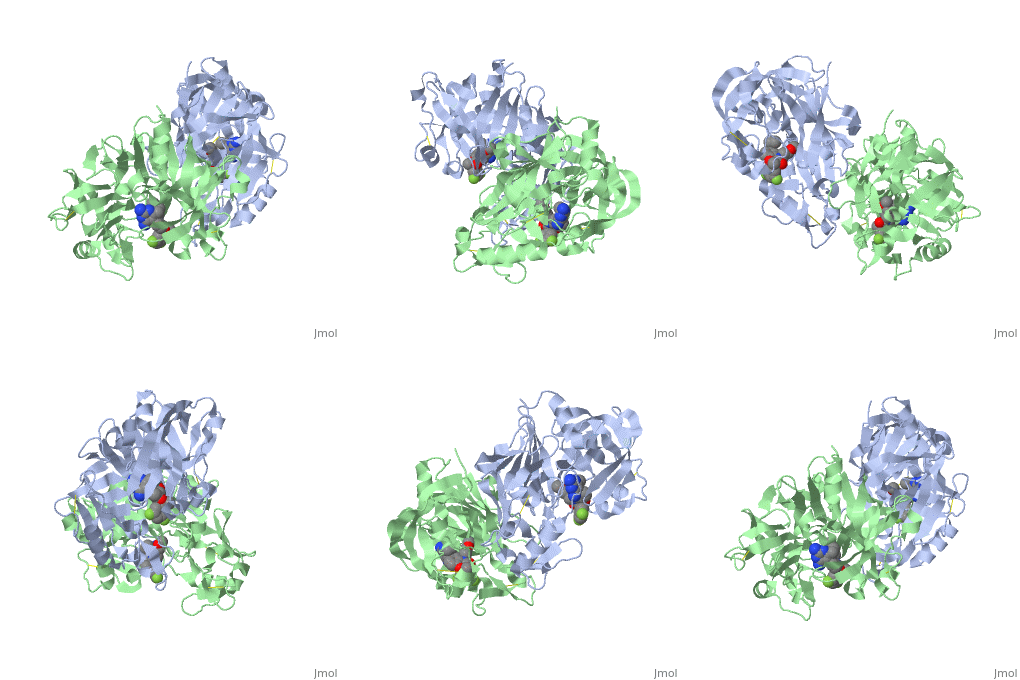
Once you have thought about the types of interactions you would expect this inhibitor COULD make at the active site of the enzyme (refer to your notes for an example)then look at the 2-dimensional "map" of the active site on your tutorial sheet and compare this to the 3-dimensional representations here. | Once you have thought about the types of interactions you would expect this inhibitor COULD make at the active site of the enzyme (refer to your notes for an example)then look at the 2-dimensional "map" of the active site on your tutorial sheet and compare this to the 3-dimensional representations here. | ||
| + | |||
This view shows the amino acid residues on the left hand side of your "map". | This view shows the amino acid residues on the left hand side of your "map". | ||
| + | |||
This view shows the amino acid residues on the right hand side of your "map". | This view shows the amino acid residues on the right hand side of your "map". | ||
Revision as of 07:57, 13 August 2014
CHEM2052_Tutorial_Example4
| |||||||||||
References
- ↑ Powell NA, Ciske FL, Cai C, Holsworth DD, Mennen K, Van Huis CA, Jalaie M, Day J, Mastronardi M, McConnell P, Mochalkin I, Zhang E, Ryan MJ, Bryant J, Collard W, Ferreira S, Gu C, Collins R, Edmunds JJ. Rational design of 6-(2,4-diaminopyrimidinyl)-1,4-benzoxazin-3-ones as small molecule renin inhibitors. Bioorg Med Chem. 2007 Sep 1;15(17):5912-49. Epub 2007 Jun 2. PMID:17574423 doi:10.1016/j.bmc.2007.05.069
