CHEM2052 Tutorial Example4
From Proteopedia
(Difference between revisions)
| (7 intermediate revisions not shown.) | |||
| Line 3: | Line 3: | ||
== '''Chem2052: Example 4 - Renin''' == | == '''Chem2052: Example 4 - Renin''' == | ||
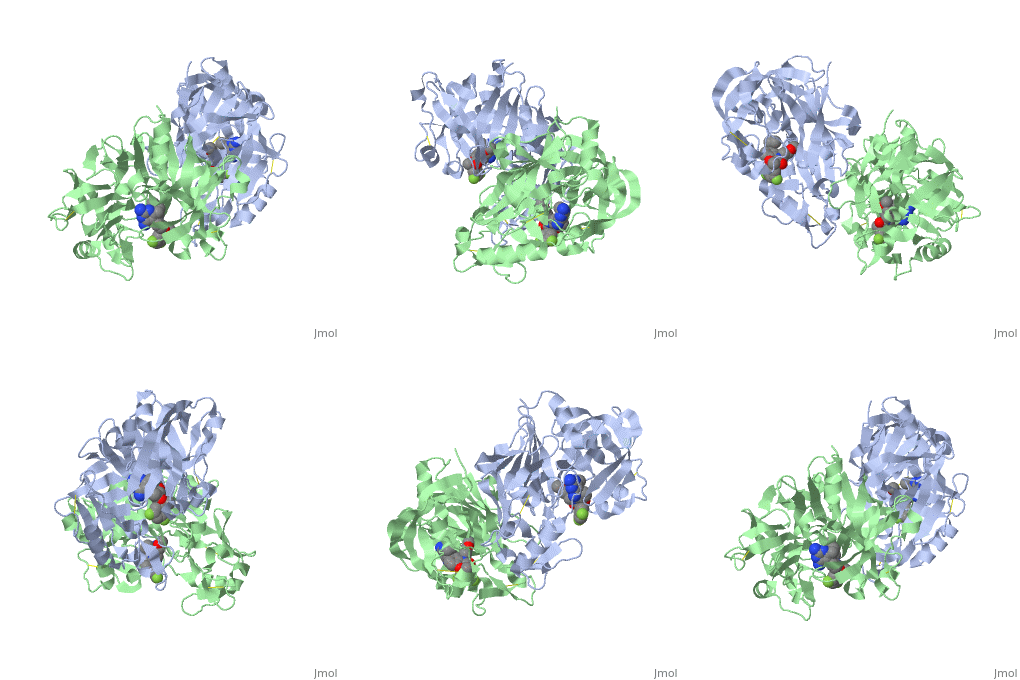
| - | The spinning structure you initially view on this page is a protease called Renin. Renin is an '''aspartyl protease''', which cleaves a particular peptide called angiotensinogen. | + | The spinning structure you initially view on this page is a protease called '''Renin''' (also known as '''angiotensinase'''). Renin is an '''aspartyl protease''', which cleaves a particular peptide called angiotensinogen. Although this enzyme functions as a monomer the crystal structure obtained is a dimer and this is what you can see here. In the following representations one of the sub-units has been removed to represent the protein in its natural state. |
== '''Background''' == | == '''Background''' == | ||
| - | In later lecture we will look a little more closely at '''Renin''' | + | In later lecture we will look a little more closely at '''Renin'''. This enzyme is involved in a biological pathway leading to elevation of blood pressure, which can be beneficial in many ways. However if this process has become overactive, hypertension (high blood pressure) can result. Hypertension leads to cardiovascular disease which is the leading cause of death globally. The World Health Organisation states "An estimated 17.3 million people died from cardiovascular disease in 2008, representing 30% of all global deaths" see the following web page if you want to know more: [http://www.who.int/mediacentre/factsheets/fs317/en/ Cardiovascular disease facts WHO]. |
Since the 1970s scientists have been trying to modulate the action of renin by blocking the active site of the enzyme and preventing its function, hence lowering blood pressure. Aliskerin is the only renin inhibitor in clinical use today [http://en.wikipedia.org/wiki/Renin_inhibitor Renin information Site]. However there is still interest in developing new, improved inhibitors. This question looks at a renin inhibitor identified through research at Pfizer.<ref>PMID:17574423</ref> | Since the 1970s scientists have been trying to modulate the action of renin by blocking the active site of the enzyme and preventing its function, hence lowering blood pressure. Aliskerin is the only renin inhibitor in clinical use today [http://en.wikipedia.org/wiki/Renin_inhibitor Renin information Site]. However there is still interest in developing new, improved inhibitors. This question looks at a renin inhibitor identified through research at Pfizer.<ref>PMID:17574423</ref> | ||
| Line 13: | Line 13: | ||
== '''Active Site''' == | == '''Active Site''' == | ||
| - | This representation illustrates the <scene name='59/596437/Renin_catalytic_residues/2'>active site catalytic residues</scene> of Renin. Consider the mechanism of the enzymatic cleavage of the natural peptide substrate | + | This representation illustrates the <scene name='59/596437/Renin_catalytic_residues/2'>active site catalytic residues</scene> of Renin. Consider the mechanism of the enzymatic cleavage of the natural peptide substrate by the catalytic residues [http://www.cambridgemedchemconsulting.com/resources/hit_identification/aspartic_protease_inhibitors.html you will find it here]. Identify the structure of the transition state. In later lectures we will see how knowledge of this transition state can be used to design very effective enzyme inhibitors which mimic this structure, as you will find out, these are (not surprisingly) called "transition state" inhibitors. But for now though we will focus on the Pfizer inhibitor. |
== '''Inhibition of Renin''' == | == '''Inhibition of Renin''' == | ||
| Line 21: | Line 21: | ||
== '''Active Site Interactions''' == | == '''Active Site Interactions''' == | ||
| - | + | This inhibitor does not just bind to the catalytic residues there are many other amino acids at the active site of the enzyme. First predict possible interaction types you would expect with this structure. Then look at the 2-dimensional "map" of the active site provided on your tutorial sheet and compare this to the 3-dimensional representations here. | |
| - | This view shows the amino acid residues on the | + | This view shows the amino acid residues on the <scene name='59/596437/Renin_interactions_rhs/2'>right hand side</scene> of your "map". You should notice that these amino acids are fairly hydrophobic and interact with the hydrophobic parts of the inhibitor. If you prefer to view the structure where the inhibitor atoms are colour coded you will <scene name='59/596437/Renin_interactions_rhs_again/1'>find it here. </scene> |
| - | + | Similarly this view shows the amino acid residues on the | |
| + | <scene name='59/596437/Lhs_aminoacids_representation/2'>left hand side</scene> of your "map". Again you can view this with the atoms of the inhibitor colour coded | ||
| + | <scene name='59/596437/Lhs_aminoacids_representation/3'>find it here</scene>. | ||
| - | == Structural highlights == | ||
| - | |||
| - | This is a sample scene created with SAT to <scene name="/12/3456/Sample/1">color</scene> by Group, and another to make <scene name="/12/3456/Sample/2">a transparent representation</scene> of the protein. You can make your own scenes on SAT starting from scratch or loading and editing one of these sample scenes. | ||
| - | |||
| - | |||
| - | |||
| - | </StructureSection> | ||
== References == | == References == | ||
<references/> | <references/> | ||
Current revision
CHEM2052_Tutorial_Example4
| |||||||||||