We apologize for Proteopedia being slow to respond. For the past two years, a new implementation of Proteopedia has been being built. Soon, it will replace this 18-year old system. All existing content will be moved to the new system at a date that will be announced here.
CHEM2052 Tutorial Example4
From Proteopedia
(Difference between revisions)
| Line 13: | Line 13: | ||
== '''Active Site''' == | == '''Active Site''' == | ||
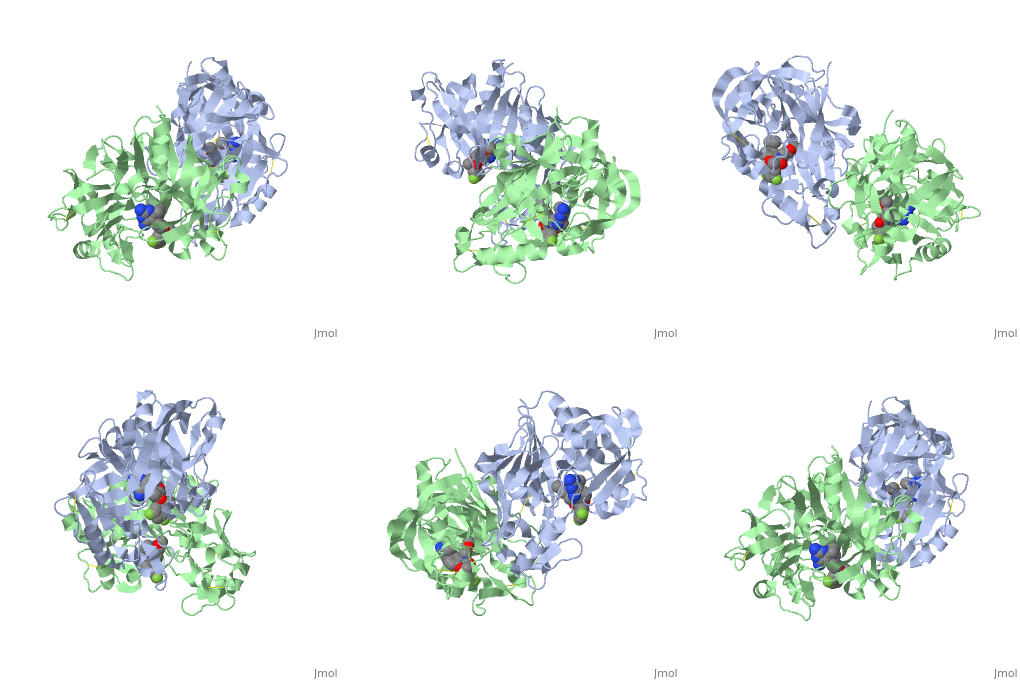
| - | This representation illustrates the <scene name='59/596437/Renin_catalytic_residues/2'>active site catalytic residues</scene> of Renin. | + | This representation illustrates the <scene name='59/596437/Renin_catalytic_residues/2'>active site catalytic residues</scene> of Renin. Consider the mechanism of the enzymatic cleavage of the natural peptide substrate angiotensinase. Identify the structure of the transition state. In later lectures we will see how knowledge of the transition state can be used to design very effective enzyme inhibitors called "transition state" inhibitors. |
== '''Inhibition of Renin''' == | == '''Inhibition of Renin''' == | ||
Revision as of 07:38, 13 August 2014
CHEM2052_Tutorial_Example4
| |||||||||||
References
- ↑ Powell NA, Ciske FL, Cai C, Holsworth DD, Mennen K, Van Huis CA, Jalaie M, Day J, Mastronardi M, McConnell P, Mochalkin I, Zhang E, Ryan MJ, Bryant J, Collard W, Ferreira S, Gu C, Collins R, Edmunds JJ. Rational design of 6-(2,4-diaminopyrimidinyl)-1,4-benzoxazin-3-ones as small molecule renin inhibitors. Bioorg Med Chem. 2007 Sep 1;15(17):5912-49. Epub 2007 Jun 2. PMID:17574423 doi:10.1016/j.bmc.2007.05.069
